
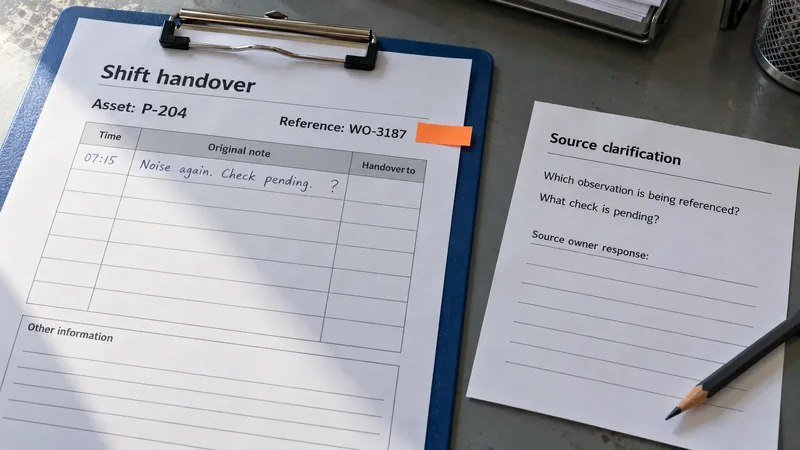
“Noise again. Check pending.” A maintenance note like this may be familiar to the person who wrote it and unclear to everyone else. Which observation is being referenced? What check is pending? Simply translating the words into another language cannot supply the missing facts. Maintenance handover translation begins by separating what the record says from what an experienced reader might assume.
For managers commissioning industrial translation, the challenge is to preserve observations, identifiers, status, and references without allowing editorial revisions to change their meaning. The materials may include shift logs, work-order comments, exported maintenance records, and attached notes. They need enough context for a translator to understand the message, and an approved source owner to resolve questions before uncertain wording becomes a final target-language statement.
Terralíngua’s ISO certified manufacturing translation services cover technical translation and localization of industrial information. Our expert approach emphasizes client terminology, reference documents, technical queries, and client review approval of technical content. These capabilities are essential for handover documentation. Any additional source-language localization should be defined in the quotation, such as a clear boundary between editing to improve the content or clarifying what action occurred.
Manufacturing and industrial translation services
Define the Purpose of Maintenance Handover Translation
First establish why the notes require translation. Are incoming personnel using them during a shift transition, is an overseas support team reviewing selected records, or is a documentation group preparing an archive? These uses differ in urgency, context, and delivery format. Identify the readers, language variants, source period, and intended use before deciding whether to translate individual entries, a complete log, or an agreed upon selection.
A handover note is a record of communication, not automatically an approved maintenance instruction. Keep its purpose visible. Translation must not convert an observation into a diagnosis, an incomplete task into a completed one, or a proposed action into an authorization. Decisions about equipment condition, maintenance priorities, and operational use remain with the authorized site personnel and the organization’s established procedures.
The UK Health and Safety Executive’s shift-handover guidance describes preparation, exchange of information, and cross-checking by incoming personnel. It recommends both written and verbal communication. This is useful context for a language project: a translated document supports communication but does not replace the site’s handover process. The guidance is cited as a UK human-factors reference, not as a universal legal requirement or a maintenance procedure.
HSE (Health, Safety, and Environment) guidance on shift-handover communication
Establish a Source Record That Can Be Traced
Provide the original entries with their surrounding context, including field headings and relevant attachments. An isolated comment copied into a spreadsheet may lose the asset tag, timestamp, or work-order reference that explains it. For exported records, retain a stable entry identifier so the translated text can be connected to the correct source row after sorting, review, and delivery.
Keep the original wording distinguishable from an edited version. If a source owner expands the shorthand text, the translation package should show which clarification was approved and who approved it through the client’s chosen process. Do not simply overwrite the underlying record for convenience. Historical records may need a faithful translation with separate explanatory notes rather than a rewritten source; so confirm the purpose before editing.
A useful reference package can include the approved equipment list, applicable terminology, the meaning of status fields, and the specific earlier entries cited in the notes. Supply only the necessary material for the assignment and apply company confidentiality controls. Remove irrelevant information without breaking the relationship between an entry and the role or record needed to understand it.
Resolve Abbreviations in Context
Do not treat a familiar abbreviation as self-explanatory. The same letters can have different meanings across plants, departments, or equipment families. A translator may recognize a common technical expression while the local writer intended something else. Ask the source owner to confirm the meaning in that entry, especially when an abbreviation affects the component, action, or reported status.
Build a focused equipment handover terminology list with the source expression, approved meaning, target-language equivalent where available, and scope of use. Add equipment or document references when it helps distinguish similar terms. Identify local informal terms separately from formal asset names. A local term can be explained, but it should not replace the identifier that connects the note to the organization’s records.
Decide which abbreviations stay unchanged because users must recognize them in a maintenance system or on a physical label. Where useful, provide an approved explanation alongside the retained form. Do not invent a new target-language abbreviation simply to match the source length. A short term that is not recognized by the intended readers can make the note less usable even when its expanded translation is accurate.
Clarify Fragments Without Adding Facts
Incomplete sentences are not automatically unsuitable for translation. A concise entry may be clear when the subject, action, and status are supported by nearby fields. The concern would be missing content meaning, not missing literary polish. Review fragments for an unclear actor, object, reference, or time relationship. Ask a focused question rather than expanding every note into a long paragraph.
Consider a sample entry such as “P-204: noise again; check pending; see previous.” The asset identifier is visible, but the rest of the text remains ambiguous. A language reviewer can ask which previous record is intended and what the word “check” refers to. The reviewer cannot infer the cause of the noise, decide whether it recurred under the same conditions, or state that a particular inspection has been scheduled.
- “See previous”: Which dated entry or record identifier should the reader consult?
- “Check pending”: What activity does “check” refer to, and what does “pending” mean in this record?
- “Done”: Which recorded task is complete, and does the note refer to that task only?
- “Same issue”: Which earlier observation is being referenced, and has the source owner confirmed the relationship?
If the content owner provides confirmation, incorporate only the approved information. For example, identifying “previous” as a particular entry allows the reference to become specific. It does not establish that the equipment has the same concerns. If the owner cannot resolve the observation, preserve that uncertainty through the agreed upon delivery process rather than making the sentence content appear conclusive.
Preserve Status, Negation, and Uncertainty
Small wording changes can substantially alter a record. “Not checked” differs from “checked, no issue noted.” “Reported” differs from “confirmed,” and “awaiting review” differs from “approved.” During translation and editing, examine these distinctions. A fluent sentence should retain the original degree of certainty and completion, including any qualifications that the source owner has approved.
Read negative wording together with its subject and time reference. A note that says a condition was not observed during a particular check should not become a claim that the condition never occurred. Similarly, “not yet” should not be removed because it seems redundant. These are language-review questions about the record’s meaning, not invitations for the translator to evaluate the equipment.
Where a maintenance platform uses controlled status values, obtain their definitions from the system or content owner. A free-text comment and a status field may describe different aspects of a task. If they appear inconsistent, raise the discrepancy instead of choosing which one governs. Agree whether displayed labels are translated, retained, or paired with an explanation; protect any underlying system codes.
Protect Equipment Identifiers and References
Classify content before translation. Asset tags, work-order numbers, drawing identifiers, part numbers, and document revisions usually serve as references rather than content text. Specify which strings must remain exact, including punctuation and leading zeros. A visually similar character can point to a different record, so reviewers should compare protected identifiers with the source rather than relying on a quick review.
Numbers and units also need the same treatment. Preserve the recorded values and do not simply convert units, correct a suspected measurement, or infer a missing unit. If a figure appears implausible, the source content owner must resolve it. Where localized decimal or date formatting is requested, confirm that the resulting notation remains unambiguous and compatible with the intended delivery system.
Shift labels and relative times deserve particular attention. “Last night” or “next shift” can become unclear when an entry is read later or at another site. Ask whether an approved date, shift identifier, or timestamp can clarify the reference. Do not supply a time zone or calendar date based on an assumption. Preserve the difference between when an observation occurred and when someone entered the note.
Check references to attachments as carefully as the main text. “Photo attached” is not useful if the export omits the photograph or renames it without a matching reference. Identify the correct attachment and decide whether its labels require translation. A photograph may clarify the object being discussed, but it does not authorize the language team to interpret an unconfirmed condition.
Give Source Owners Questions They Can Answer
Use a short query log with the entry identifier, original wording, specific question, approved answer, and resolution status. Keep the question neutral. “Does ‘done’ refer to the inspection or the entire work order?” is a more useful query than proposing a completed repair that the source never mentions. Link each answer to all affected language versions so clarifications do not diverge.
Name the client contact authorized to route content questions to the relevant source owners. The person coordinating translation may not have observed the event and should not be expected to reconstruct it. If contributors disagree, return the issue for internal resolution. The translation provider can explain linguistic ambiguity and its consequences but should not decide which account is factually correct.
Set a delivery rule for unresolved entries before work begins. Depending on intended use, the client may hold an entry for clarification or authorize a clearly identified provisional rendering with separate query notes. Unconfirmed contact can hide in a finished-looking file. Operationally urgent matters must follow the site’s established communication channels; a pending translation query is not an alternative escalation process.
Keep the Translation Connected to the Record
Agree on the output format early: a bilingual review table, a translated report, or text prepared for a defined import process. Include the entry identifiers and field structure needed to maintain traceability. A bilingual table can help reviewers compare wording, but it is not automatically suitable for reimport into a maintenance system. Confirm the receiving format and who is responsible for the content import.
If records come from a computerized maintenance management system, or CMMS, provide the relevant export specification and a sample. Identify translatable labels and comments separately from system fields. Check character support, line breaks, and field limits in the determined format. If a translation exceeds a limit, agree upon an approved concise form or another delivery approach rather than truncating the message.
For handwritten or scanned notes, establish transcription before translation. Optical character recognition can help extract text, but uncertain characters, crossed-out words, and crowded identifiers still require checking against the original. Clearly mark unreadable content and ask for confirmation. A cleanly typed transcription should not conceal illegible parts in the source.
Review Meaning Before Releasing the Language Version
Separate linguistic review from technical confirmation. A language reviewer checks whether the translation preserves the approved message and terminology. The client’s source or technical owner confirms that clarifications represent the intended observation and that the material is appropriate for its stated use. A formatting or systems reviewer checks that the translated content remains attached to the correct entry after export or import.
- Every translated entry maps to the correct source identifier and revision.
- Protected asset tags, work-order references, values, and document identifiers remain accurate.
- Abbreviations follow approved definitions within their documented scope.
- Negation, uncertainty, completion status, and time relationships retain their meaning.
- Approved query answers appear consistently wherever they apply.
- Unresolved or unreadable content remains clearly identified under the agreed delivery rules.
- No language edit adds a diagnosis, maintenance action, or authorization absent from the approved source.
- The delivered file displays complete text without truncation or broken record associations.
Review selected entries in their final context, not only in an isolated translation table. A correct comment placed beneath the wrong asset heading is still a failed deliverable. Check an entry with an attachment, one with an abbreviation, and one that requires clarification. This targeted review tests the connections most likely to be lost during preparation and formatting.
Improve Shift Note Clarity in Recurring Work
Short notes can require substantial review when they contain dense shorthand or missing context. Effort depends on source quality, handwriting, the number of unfamiliar terms, export preparation, language variants, and the availability of source content owners. A representative sample is more useful for estimating the assignment than a word count alone. Include difficult entries in the sample instead of selecting only the clearest ones.
For recurring assignments, maintain approved terminology and a concise writing guide for contributors. Encourage specific references and clear status wording within the organization’s existing forms. Reuse approved translations only when the context still is applicable. A sentence from a previous shift is not evidence that the same condition, equipment configuration, or task status applies now.
When a source owner corrects a record after translation, identify the changed entry and affected language versions. Keep the correction traceable through the client’s record-management process. Do not overwrite historical wording or redistribute an edited export without confirming how the revision should be represented. Translation delivery should support that process rather than create a separate, conflicting record.
This work differs from translating approved work instructions: handover notes describe or report a situation, while instructions tell readers how an authorized task is to be performed. Where a note cites instructions, provide the relevant approved reference without converting the note itself into a new procedure.
Translating factory work instructions for multilingual teams
Frequently Asked Questions
Can We Send Notes That Combine Two Languages?
Yes, but identify the languages and the intended meaning of local expressions. Preserve identifiers and supply context for mixed-language abbreviations. Confirm whether the final deliverable should be entirely in one language or retain labels that users need to recognize in the source system.
Should We Correct Grammar Before Sending Notes?
Correct obvious typing errors only within your approved process. Grammar editing is useful when it clarifies an already established meaning; it is risky when it supplies missing facts. Keep the original available and have the source owner approve substantive expansions before they become the translation source.
Can Automated Translation Handle Routine Entries?
Repetition can make entries look predictable, but a changed negative, identifier, or status can change the message. Any automated workflow needs the organization’s approval, appropriate confidentiality controls, and review suited to the intended use. It cannot resolve an observation that the source owner has left unclear.
Prepare a Representative Sample for Assessment
To discuss maintenance handover translations with Terralíngua, send a representative sample, target languages, intended readers, required format, and deadline. Include relevant equipment terminology, source-record references, and a contact for clarification. Ask the team to assess the industrial translation and any required editing separately, so the scope improves language clarity while preserving responsibility for the underlying facts.