By Terralíngua
A machinery safety label can contain only a few lines, yet translating it may require more preparation than a much longer passage in a manual. The words must remain connected to a specific hazard, approved instructions, and physical location. Machinery label translation preparation brings those references together before the consideration of available space for production consideration.
For equipment manufacturers, the challenge is to deliver readable language versions without weakening the approved message. Technical translation addresses meaning and terminology; graphic adaptation places that content into usable artwork. Terralíngua provides machinery translation and multilingual desktop publishing to address these needs. Please note the client’s safety specialists will still remain responsible for approving hazard content, applicable requirements, and the label’s suitability for the equipment.
Start with the Approved Meaning; Not with a Character Limit
Identify the approved source version before asking anyone to translate or shorten a label. A drawing attached to an old purchase order may differ from the current safety file. Confirm which version governs the project content and whether any source wording is awaiting approval. Keep uncertain labels on a query list rather than treating them as final.
Record the relationship between the hazard description, possible consequence, and avoidance instruction wherever these appear in the approved source. A translator will need to understand what each phrase does. Words describing when an instruction applies, which component it concerns, or who may perform an action are often crucial even when they may look unessential during the layout process.
Treat signal words as controlled safety content. Do not replace one word with a shorter or more familiar alternative to make a line fit. The client should be asked to identify the governing labeling system and confirm any approved target-language terminology. Where an approved equivalent has not been supplied, raise the question for a qualified resolution instead of self-determining a severity classification.
ISO 3864-2 addresses design principles for product safety labels, including those on industrial equipment. Its scope does not establish which requirements govern a particular machine or destination. The client’s safety specialist should identify the applicable standards, editions, and market requirements for the product. Though this article offers translation-project guidance, it is not a substitute for that assessment.
ISO 3864-2: Design Principles for Product Safety Labels
Machinery Label Translation Preparation: Assemble the Source Package
Create an inventory that gives each label a stable identifier. Link that identifier to its approved source text, artwork revision, machine model, target languages, and placement reference. Similar-looking labels should remain separate considerations when their instructions or applications differ. Conversely, an approved repeated message can be identified for consistent treatment across the document set.
Also identify repeated text that is similar but not identical. Two warnings may share most of the wording while referring to different access points or operating conditions. Reuse can support consistency, but every proposed match needs to preserve those differences. A short label should not be approved solely because it resembles a previously translated message.
- Approved editable artwork and a reference PDF showing the intended source appearance.
- Text content associated with individual label identifiers, including signal words and small-print instructions.
- Finished dimensions, usable text areas, reserved symbol areas, and printer-supplied production specifications.
- Equipment photographs or placement drawings identifying the relevant surface, component, and orientation.
- Approved terminology, related manual passages, language variants, and designated technical reviewers.
Distinguish the finished label size from the available content space. Borders, reserved symbol panels, margins, and other fixed elements may reduce the usable area. Supply the actual dimensions and units rather than a generic screenshot whose scale is unknown. Explain which elements are fixed and which may change after authorization.
Identify the permitted fonts before composition starts. A substitute font can change line lengths, character coverage, and the appearance of emphasis. Confirm who will supply the licensed fonts and who will approve font substitutions. If one language requires a different font, evaluate its actual size in the layout proof rather than assuming the same source font size produces an equivalent visual result.
Editable text and vector artwork usually make layout adaptation more manageable. If text has been converted to outlines, the visible letters may no longer behave as editable text. Provide a verified text master to reference alongside the artwork. When only a photograph or scan exists, arrange source transcription and approval before translation; an unclear character should not become an assumed instruction.
Related Reading: Preparing Legacy Equipment Documents When Editable Files Are Missing
Give Translators a Physical Placement Reference
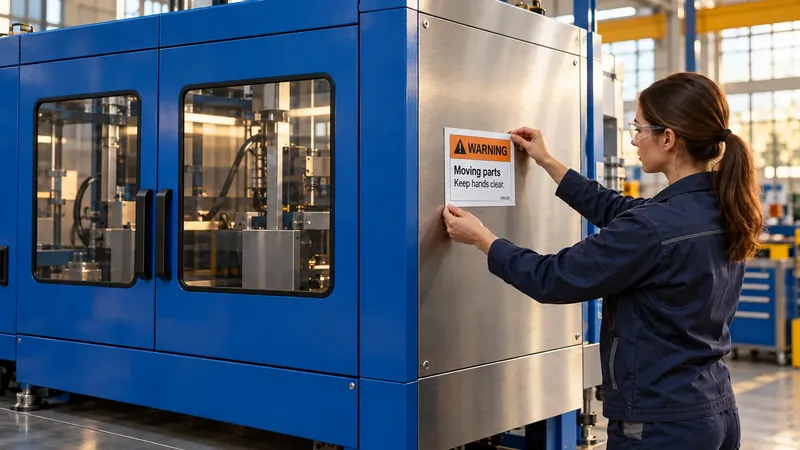
A label detached from its machine can be ambiguous. A short reference to a cover, guard, access panel, or connection may describe different components across a product family. Supply a visual reference such as a photograph with the label location identified and a corresponding drawing or equipment reference. The translation team should not have to infer the intended component from a cropped image.
Include the installed orientation and relevant model configuration. State whether a label appears on a fixed surface, a removable cover, or several locations. These details help reviewers assess references such as “above”, “inside”, or “behind”. They do not authorize the translator to choose a safer placement location or redesign the machine’s warning system.
Keep content or image placement approval separate from language approval. A correct translation can be placed in the wrong location in a production package. The client should confirm that the localized artwork file connects to the intended installation reference. If a proposed larger label requires a different position, return that decision to the responsible equipment and safety reviewers for confirmation.
Confirm the Label Layout Will Retain Text Meaning
Translated text may occupy more or less space than the source text, and character counts alone do not predict fit. Font metrics, writing system, word lengths, and line breaks all matter. Test representative labels early, including dense messages and the smallest available formats, using the intended fonts and actual artwork dimensions.
When translated text does not fit, first check whether the layout effectively uses the approved space. An unnecessary hardline break or an undersized text frame may need correction. Assess the layout changes permitted with the production team. A larger format, revised panel arrangement, or separate language variant may be possible, but each needs the appropriate approval.
If wording still needs revision for the layout, distinguish linguistic concision from a technical change. A fluent, shorter expression may preserve the complete instruction; removing a condition or substituting a broader component name may not. Have the translator explain the proposed change and obtain the required technical approval before using it. Record the accepted wording in an approved glossary and style guide for subsequent labels.
Consider this sample example in which an approved project instruction includes a condition specifying when a protective cover may be opened. The translation exceeds the text frame by one line. Deleting the condition would change the message. The translation team instead submits two clearly identified options to the client: a complete translation in a revised layout, and a more concise translation retaining the condition for linguistic and safety review. Neither becomes final production artwork until approved by the client.
The review record should show the original wording, the complete proposed translation, the space constraint, and the decision requested. Where reviewers cannot understand the target language, an explanatory note can help them understand a proposed change, but it does not replace a qualified target-language review. Avoid circulating a proposed shortened draft that could be mistaken for an approved version.
Avoid treating issues with smaller fonts, compressed text, or reduced spacing as automatic formatting solutions. Ask the client safety specialist to define the relevant legibility criteria and the production team to demonstrate the result at final size. The acceptance question is whether the approved message remains complete and usable, not simply whether the software reports that all text fits.
Keep Pictograms and Language Decisions Connected
Supply the approved pictogram files and their references, not just a visual approximation copied from another machine. ISO 7010 is a source of registered safety signs. Selecting the appropriate sign and determining its applicability belongs with the client’s qualified safety reviewers. The translation brief should identify which supplied graphics must remain unchanged.
ISO 7010: Registered Safety Signs
Do not redraw, recolor, mirror, crop, or replace a safety pictogram as an ordinary localization adjustment. Likewise, do not assume that adding a symbol will permit removing approved words. A symbol and its accompanying message need to retain the relationship specified by the client. Flag apparent inconsistencies for resolution before producing the final language versions.
For languages with different text direction, review the text arrangement without automatically reversing the machinery illustration or directional elements. Mixing text scripts, model identifiers, and punctuation can introduce additional layout issues. Ask a qualified language reviewer to inspect the composed label, while the client technical reviewer confirms that the graphic still represents the intended situation.
Plan Multilingual Warning Artwork as a Controlled Set
Decide early in the process whether the project calls for one combined multilingual label or separate language-specific versions. A combined design concentrates more text in one space; separate versions require reliable selection and installation controls. Neither approach is universally preferable. The client should select an arrangement that meets the equipment’s intended use and applicable requirements.
Maintain a language-and-model matrix showing which approved labels belong to each configuration. Include regional language variants where needed and identify intentional untranslated elements, such as product codes. Avoid file names that differ only by an unexplained number. A consistent identifier, language code, and revision make the intended output easier to trace.
Separate the internal label identifier from any identifier printed on the label itself. The internal code helps manage files and approval records; it should not appear in the artwork unless specified. Likewise, distinguish a language version from a new engineering revision. These distinctions help purchasing, production, and service teams request the correct placement.
Connect the label set to relevant manual references without assuming every occurrence should have identical wording. A manual may provide additional explanation, while a label carries a concise approved message. Terminology and meaning should align; context still matters in the consideration. Escalate contradictions for client resolution rather than simply copying whichever version happens to be shorter.
When the source changes, identify every affected language and placement variant. A small revision to a qualifier can require renewed language review and artwork approval. Supply a clear change record rather than a replacement folder with no explanation. Retain superseded versions separately so a printer or installer does not accidentally select them.
Review Composed Labels with the Production Proof
Reviewing translated strings in a spreadsheet is useful, but it is not the final language check. Once the text is composed and completeness reviewed, then the characters rendering, line breaks, and the relationship between message sections should be checked. A correct sentence can become difficult to interpret when a qualification is visually detached, or a line disappears outside its frame.
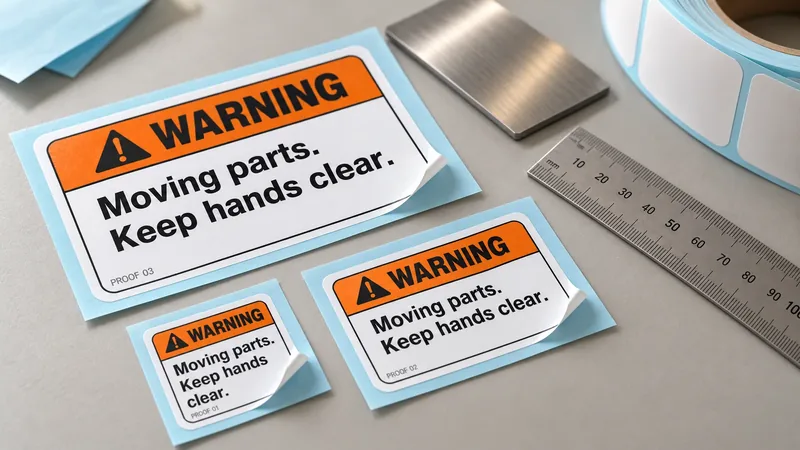
Review a proof at the intended physical size, with the printing settings in place to avoid unintended scaling. A large on-screen preview can conceal cramped text. Have the client confirm the proof against the agreed context and safety criteria. Material durability, adhesive selection, and suitability for the operating environment are separate technical and manufacturing decisions, not outcomes of translation.
Ask the printer to confirm how the supplied file will be processed. Embedding fonts, converting text to outlines, or exporting to another format can affect the production package and future editability. Agree which approved proof version is the release reference and how changes after approval will be reported. Do not let a convenient export overwrite the editable master.
- Content: Every approved message element is present, with terminology and signal words resolved.
- Language: A qualified reviewer has checked the final composed version, including punctuation and writing-system behavior.
- Artwork: Dimensions, supplied graphics, text visibility, and agreed printer specifications have been checked.
- Applicability: The client has confirmed machine configuration, placement references, and required language variants.
- Release: The approved revision is identifiable, unresolved questions are closed, and release authority is recorded.
Keep reviewer comments tied to label identifiers and specific language versions. Consolidate conflicting suggestions for confirmation before revising artwork. If the printer later changes text, fonts, or layout, send the affected proof files back through the relevant checks. Approval of an earlier PDF should not be assumed to cover a materially different production file.
Define Deliverables, Effort, and Approval Responsibilities
Agree whether delivery includes all translated text, editable language artwork, production PDFs, or what is defined as the complete package. Specify the required authoring format and printer requirements. For maintainability, retain an editable text version even if the production process requires an outlined copy. Include the language matrix and approved terminology or decision records when they are part of the agreed scope.
Word count captures only part of the effort. Many short labels can require extensive context checking, terminology decisions, and separate proofs. Missing artwork, tightly constrained dimensions, multiple equipment variants, and unresolved source questions add time to the scope of work. A representative sample at the project onset helps establish the scope more reliably than counting words in a spreadsheet alone.
Build client reviewer availability into the schedule. Identify who can approve source corrections, target-language wording, layout changes, and final release. Allow for an acceptable return cycle, especially when a reviewed proof exposes a space problem. If the source file is not final, agree on a controlled sequence for label approval the process for later revisions rather than assuming a turnaround.
How Terralíngua Can Support Your Project
Terralíngua’s heavy machinery services include ISO certified technical translation and localization for equipment documentation. Its multilingual desktop publishing services address complicated translated layouts including text expansion, different writing systems, and localized graphics. Our decades of graphics experience include multilingual Illustrator and Photoshop returns. Our industry capabilities will expertly prepare your language content and adapt to your supplied label artwork, subject to assessment of the files and scope.
Ensure translation and graphics are assessed if the labels require both services. Provide the approved source package files for evaluation with your stylistic and terminology preferences. If approved, your project should specifically assign the client approval and printer responsibilities; language and artwork services alone do not establish regulatory compliance or authorize a label for use on machinery.
Explore Terralíngua’s Heavy Machinery Translation Services
Review Terralíngua’s Multilingual Desktop Publishing Services
Frequently Asked Questions
Can We Translate Only the Label Content That Has Changed?
Yes, if the client identifies the affected label revisions and provides enough context to verify consistency. Include unchanged related labels and manual passages as references where relevant. Confirm whether a source change also affects other models or language combinations before limiting the production scope.
Can a Distributor Approve Translated Wording?
A distributor may provide valuable language and market feedback. However, assign approval according to the person’s qualifications and authorized role. Familiarity with customers does not automatically establish responsibility for hazard wording, signal words, or technical release. Resolve conflicting suggestions through the client’s designated safety owner.
Can QR Codes Solve the Space Problem?
Do not assume a QR code can replace information approved for the physical label. Determining if linked information supplements a label requires assessment for the intended equipment and market. If a QR code is included in the scope of work, define responsibility for the destination, language selection, availability, and updates alongside the physical artwork.
Preparing a Label Set for Assessment
To discuss a machinery label project with Terralíngua, share representative approved labels, editable source files, physical dimensions, placement references, target languages, and intended audiences. Include required delivery formats, printer specifications, the deadline, and the designated safety contact responsible for approval. Together, these inputs support a clear scope for technical translation and graphics adaptation while preserving the decisions that belong to your equipment specialists.
Request a Quote for Machinery Label Translation and Graphics Adaptation