
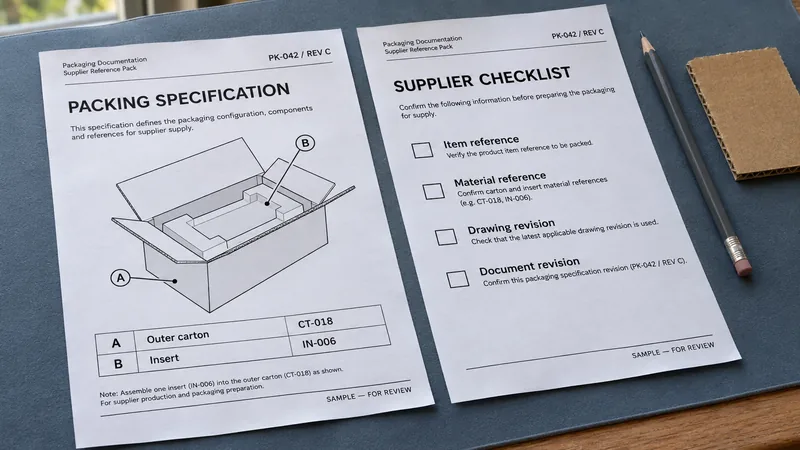
A supplier may receive a packing specification, an illustrated assembly sheet, handling notes, and a shipment checklist as separate files. Each can read well in translation while referring to a different carton, insert, or revision. Supplier packaging instruction translation therefore needs to preserve the connections between documents, not simply produce fluent versions of packaging sentences.
For purchasing, supplier quality, and localization teams, the practical question is how to give suppliers consistent language for an approved packaging configuration. This article covers the information needed to translate that configuration, adapt its graphics, and prepare usable documents. Terralíngua provides ISO certified technical translation and multilingual document production. The client’s packaging, logistics, and safety specialists remain responsible for determining the underlying requirements and approving their application.
Define the Supplier Packaging Instruction with the Translation Package
Start by identifying what the supplier must understand and which documents communicate it. For example, a packaging supplier that is manufacturing an insert needs different information from a component supplier packing finished items for dispatch. A receiving team may need another view of the same requirements. Specifically identify those audiences, including their language variants, rather than ordering one generic translation for everyone involved.
Map the materials to their functions. The packing specification may identify the approved configuration and materials. A drawing may show component relationships. Handling instructions may state conditions established by client specialists. A checklist may record whether specified checks were completed. Identify which file governs each subject and where another document merely repeats or summarizes it. Repetition without clear ownership makes inconsistencies difficult to resolve.
This scope differs from a product catalog, where descriptions help readers compare products, and from factory work instructions, where employees follow a production process. Here, the central challenge is communicating the final packaging arrangement across organizational boundaries. The supplier needs to recognize the same item, material, illustration, and revision throughout the package, even when descriptive wording changes between languages.
Establish Approved Item and Material References
Provide an approved reference list before translation begins. Include item numbers, packaging component codes, drawing identifiers, revision designations, and the source descriptions associated with them. Distinguish the product being packed from its packaging materials. A word such as “part” can refer to either, especially when a short spreadsheet heading has been copied into several documents without explanation.
State which references must remain unchanged. An item code is not a phrase to localize, and its punctuation, leading zeros, or letter case may be crucial to the client’s systems. Keep a protected reference beside the translated description. Where a supplier uses its own code for the same material, provide an approved correspondence rather than asking the translator to infer equivalence from similar names.
Material descriptions also need context. “Pad,” “liner,” “separator,” and “insert” may describe different functions in the package. Supply photographs, approved drawings, or samples of existing terminology to clarify those distinctions. If two source terms identify the same component, ask the owner whether they should be standardized. If they identify different components, the target language must preserve that difference even when everyday usage would treat them as synonyms.
Distinguish Approved Variants from Translation Differences
Suppliers may need different packaging configurations for different item families or destinations. Specifically Identify each approved variant in a style guide, with its own applicability statement and references. Do not use a language code as the only way to distinguish a technical variant: as a Spanish document might describe several approved configurations, while one configuration might need several languages. Keeping those dimensions separate helps reviewers determine whether a difference is intentional.
Where content is shared across variants, mark the common sections and the approved exceptions. For example, a common introductory paragraph may be reused while the material table differs. Review the assembled document for each variant, not just the translated fragments. A correct shared paragraph can still be misleading when it appears above the wrong configuration table or inherits a heading from another supplier package.
Resolve Conflicting Specifications and Language
Before translating, compare the main specification with its attachments and supplier checklist. Look for conflicting quantities, component names, revision references, and conditions. The language team can flag discrepancies, but it should not decide which packing method is correct. Assign a content owner who can provide a documented answer and authorize any resulting changes to the source package.
Consider this fictional example: a drawing identifies an insert as IN-006, while a checklist still names it as IN-005. Continuing the discrepancy in the translation preserves the error rather than correcting it. If a translator corrects the discrepancy, it introduces an unsupported technical decision. The translator should raise a focused question naming both files and asking the content owner to confirm the applicable reference and affected revisions.
Record the content owner answers in a shared query log with the relevant document, location, decision, and approver. Distinguish the clarification of existing meanings from new technical requirements. If an answer changes the source content, distribute the corrected source to everyone working on the language versions. A private email explaining the intended meaning is not a dependable substitute for providing an updated document.
Make Specific Conditions, Quantities, and Sequences
Short packaging statements often rely on context that a supplier may not share. “Add protection if required” leaves the trigger and decision-maker unclear. “Pack separately” does not identify what must be separated. Ask the source content owner to specify the intended condition or reference the approved instruction that defines it. Translation should preserve an established decision, not create a practical rule from an ambiguous phrase.
Check the scope of quantities and units. Does a count apply per item, inner package, outer carton, or shipment? Does a dimension describe the product or the package? Preserve the approved values and their relationships. Establish conventions for decimal notation and unit presentation and require client authorization for conversions. A language change alone is not a reason to substitute locally familiar dimensions or materials.
Sequence requires the same care. Keep prerequisites, conditional steps, and exceptions attached to the actions they qualify. Where the source refers to “before closing” or “after inspection,” identify the relevant operation and responsible party. If the package contains handling or safety wording, preserve its force and limitations, with questions returned to the designated specialist rather than softened to make the wording sound more conversational.
Keep Illustrations and Translated Text Connected
Supply editable artwork wherever possible, together with an approved reference PDF. Text can appear in callouts, legends, image captions, drawing notes, and embedded screenshots. Mark which elements need translation, and which are protected identifiers. Include images that establish orientation and component identity so that a short label is interpreted in relation to the actual packaging configuration.
Use stable callouts to connect the illustration with the component list and instructions. If callout B identifies an insert, its translated description must still identify that insert everywhere it appears. Do not renumber callouts merely to match a different reading order without approval. A right-to-left language may require different text placement, but that does not authorize mirroring the physical drawing or reversing its technical meaning.
Review the adapted illustration at its intended output size. A longer label may cross a leader line or appear to identify a neighboring component. Moving the label can be appropriate; moving the leader endpoint changes the reference. Agree which production changes the graphics team can make and which require technical approval. When artwork is flattened, assess reconstruction effort before promising an editable multilingual drawing.
Treat Handling Symbols as Controlled Content
Symbols and written instructions should be reviewed together. ISO 780:2015 describes graphical symbols for conveying handling instructions on distribution packages; however, its scope does not include instructions specific to dangerous goods. That distinction matters when a source package combines ordinary handling information with other markings. A familiar-looking symbol is not evidence that every requirement has been addressed.
ISO 780:2015: Scope of Graphical Symbols for Handling and Storage of Packages
Ask the client’s specialists to identify the applicable symbols, approved artwork, accompanying wording, and any placement requirements. The translation assignment should state whether it includes only surrounding text or also the production preparation with the supplied artwork. Do not replace a symbol with a decorative icon or add a symbol because it appears to summarize a sentence. Those are content owner decisions requiring appropriate authorization.
Handling document localization can improve the clarity and consistency of approved instructions, but it does not validate the package design or determine transport requirements. Where a shipment has special conditions, the responsible specialists must supply the applicable information. Keep unresolved questions visible in the review record and prevent a polished layout from being mistaken as final technical approval.
Design Supplier Checklists Around Clear Answers
A translated checklist should make clear what each response means. Separate instructions to perform an action from statements used to confirm completion. “Check material reference” and “material reference verified” serve different purposes, even if they appear beside similar boxes. Ask the document owner about the form intention and preserve that function in the target language.
Define response choices and exceptions. An empty box should not have to carry several meanings such as incomplete, not applicable, or awaiting approval. If the approved form provides those distinctions, translate them consistently and preserve the space needed for explanations. If it does not, flag the ambiguity rather than adding new response categories without permission.
Keep the criterion beside its response field when formatting the document. A page break that separates a condition from its checkbox can make the form difficult to interpret. Test a representative completed example using fictional data to check whether instructions, references, and entries remain associated. This review assesses the document’s usability; but it does not establish that the supplier performed the underlying physical checks.
Make the Supplier Handoff Clear
Agree how the supplier will identify the released and approved language version. A delivery manifest can list the document identifier, language, source revision, target revision, and included attachments. Explain whether the supplier should return comments, acknowledge receipt, or complete an accompanying form. Those actions should follow the client’s established process; a translated file arriving by email should not leave the recipient guessing about its release status.
If the supplier reports difficulty understanding a translated instruction, capture the exact wording and the document version before revising it. The issue may be a language choice, a missing attachment, or a technical assumption in the source. Route it accordingly. Making a quick local edit without checking related documents can create a second unofficial version that later suppliers might continue to reuse.
Keep filenames informative without making them the sole source of control. The document itself should carry the agreed upon identifying information, because printed pages and downloaded attachments can become separated from their original folder. Confirm how superseded review copies will be distinguished from released files.
Assign Language, Technical, and Production Review
Define review responsibilities before distributing proofs. The language reviewer checks meaning, terminology, grammar, and consistency. The client’s technical reviewer confirms item applicability, materials, quantities, sequence, and approved handling requirements. The production reviewer checks layout, character display, callout placement, and file output. These perspectives complement one another, and none should be assumed to cover every other responsibility.
Supplier feedback can reveal unfamiliar terminology or unclear references, but it needs a defined approval route. A supplier may propose a locally familiar material name that denotes a substitute. Record the suggestion in the style guide and ask the authorized owner to confirm equivalence before finalizing the entry. Distinguish terminology preferences from proposed changes to materials or methods so that a linguistic review does not become an informal engineering change.
Request consolidated comments against a named proof version. Reviewers should identify the affected location, explain the issue, and provide an approved correction where possible. If two reviewers disagree, route the conflict to the designated content decisionmaker. After corrections, check the affected text and its connected references again; as an approved wording change may require adjustments to a caption, table, or checklist entry.
Agree on Deliverables and Acceptance Criteria
Specify whether suppliers need editable documents, controlled PDFs, print files, or a combination. Identify page size, language arrangement, and any template restrictions. A bilingual proof can help comparison during review, while separate language files may suit distribution better. Establish the final deliverable format with the client rather than assuming that every deliverable must reproduce the source page count.
- All agreed text, illustration labels, captions, and checklist fields are present in the intended language.
- Protected item and material references match the approved source and correspondence list.
- Conditions, quantities, units, and exceptions retain their approved meaning.
- Callouts, tables, and response fields remain connected to the correct content.
- Document and drawing revisions are identified consistently throughout the delivery.
- Required client decisions are resolved and the agreed reviewers have approved the release.
Use these best practices as a starting point for project-specific acceptance criteria, not as a substitute for technical validation. State who confirms each criterion and how issues will be recorded. Include a final check of the actual exported files, because a correct editable source does not guarantee a correct PDF. Retain the approved files and review record so that later questions can be traced to the final released version.
Plan Updates Across the Complete Document Set
A packaging change may affect more than the paragraph that describes it. A replacement insert can alter the component list, illustration, captions, and checklist. Provide a change record identifying the affected references and the approved new source. Do not rely only on highlighted text if the artwork or attachment revision also changed.
For repeat orders, confirm whether the existing language package still applies to the current item and supplier arrangement. Previously translated wording can support consistency, but it should not carry forward an obsolete reference. Identify who withdraws superseded files and distributes replacements. Translation delivery and supplier release are separate events; the client should control when each version becomes applicable.
Effort and schedule depend on the number of languages, source clarity, artwork editability, repeated variants, and review availability. A short specification with many embedded labels can require substantial production work. Supply a representative sample early for evaluation, including its attachments, so that preparation and review can be assessed together. Unresolved technical decisions should be visible in the project plan rather than hidden inside a translation deadline checklist.
Prepare a Coordinated Translation Request
Terralíngua’s ISO certified professional services include translating technical specifications and manuals, adapting graphics, and formatting multilingual documents for print and digital use. For a supplier packaging project, those capabilities can be scoped around the approved specifications, illustration text, handling documents, and checklists. The reference-control and acceptance practices described here are project recommendations, not a claim that translation replaces packaging or logistics approval.
To request an assessment, provide the current source package, approved item and material references, target languages and supplier audiences, required file formats, and requested deadline. Include editable artwork, the approved reference PDF, any known uncertainties, and the person responsible for content technical decisions. That gives the project team a practical basis for assessing translation needs, graphics adaptation, document layout, and the review time needed before supplier release.
Discuss Multilingual Document Formatting and Source-File Requirements with Terralíngua