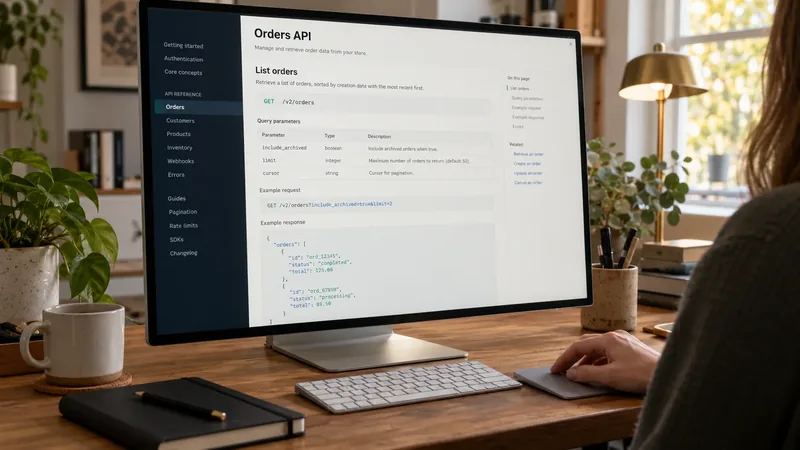
By Terralíngua
API (application programming interface) documentation helps developers understand how to request information, submit data, and handle results. Translating this documentation requires a careful boundary: explanations should be accessible in another language, while the elements that identify or operate the interface must remain reliable. API translation planning defines that boundary before files enter the language localization workflow.
A translated guide can read fluently and still mislead a developer if a parameter name changes, a condition disappears, or an example belongs to another release. Technical translation and documentation localization address the language concerns surrounding those details. Terralíngua expertly supports software and technical documentation localization; however, the client’s developers retain responsibility for API behavior, integration, and executable-example validation.
API Text Translation Starts with the Reader
Identify who will use the translated material and what they need to accomplish. A partner engineer integrating an established service may need precise endpoint references, while a new developer may additionally require an onboarding guide and explanations of authentication concepts. Define the audience’s product knowledge and preferred language without assuming all developers want every technical term translated.
Inventory the actual publication set such as introductory guides, endpoint descriptions, parameter tables, authentication instructions, tutorials, response examples, and troubleshooting notes. An API, or application programming interface, may be documented across several systems. State which materials are included and how readers will navigate between translated and intentionally untranslated pages.
If the first release covers only part of the documentation, choose a complete reader journey. Translating an introductory tutorial without its required authentication page can leave a practical gap. Mark the coverage clearly and agree how links to source-language material will be presented. This is a scope decision, not a reason to translate every page at once.
Choose an Approved Version and Maintainable Source
Record the API version, documentation revision, and relevant sample or SDK (software development kit) versions. An SDK may provide its own names and usage patterns. These versions need not share one number. Ask the product owner to confirm that the supplied materials describe the same supported behavior before treating them as an approved baseline.
Provide editable source files or a structured export, together with a rendered reference showing the intended reading experience. Documentation may originate in Markdown, a content management system, or an API description file. Explain how the published pages are generated and which source is the authoritative one. Translating a generated page on its own could expose it to be overwritten in the next build.
For teams using OpenAPI, its specification distinguishes descriptive fields from structural elements such as paths, parameter names, and operation identifiers. That distinction is useful when defining the translation scope, but it is not a ready-made localization workflow. Have the documentation owner approve eligible fields and exclusions for the version and tooling in use.
OpenAPI Specification: Structure and Field Definitions
Agree on a production route your team can maintain. Including how to confirm the source file scope, the review process, and how to provide an approved text export with stable identifiers, or another supported exchange format. Confirm compatibility using a representative sample. Do not assume a translation provider can connect automatically to your repository, run your documentation pipeline, or publish changes; explicitly assign those tasks.
Test the proposed handoff with a small but varied selection such as one explanatory page, one parameter table, a code block, and an example response. Confirm that the returned material can be reintegrated without losing identifiers or context. Resolve format and ownership questions during this pilot rather than discovering them after every language version has been completed.
Separate Explanatory Text from Protected Elements
Classify content by its function rather than appearance. A word in an endpoint path is not ordinary text even when it looks familiar. Conversely, a description stored inside a structured file may be intended for readers. Create an approved translation map that identifies translatable passages, protected content, and items requiring a decision.
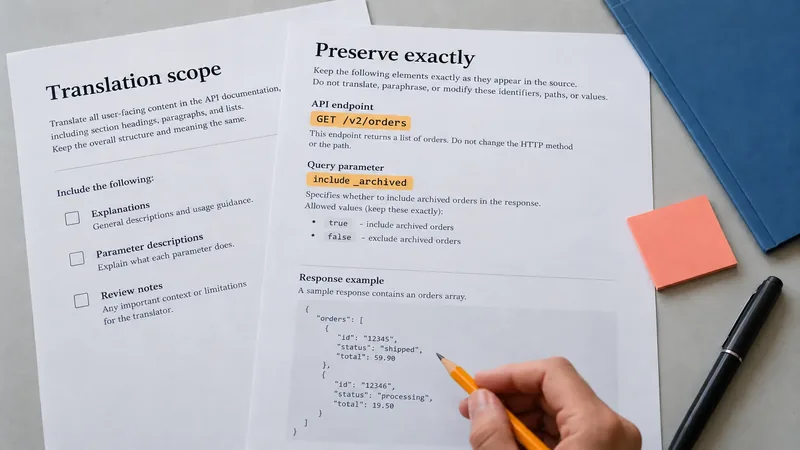
- Translate content as agreed: explanations, introductory paragraphs, parameter descriptions, caution notes, and reader-facing headings.
- Preserve as specified: endpoint paths, HTTP methods, parameter names, property names, operation identifiers, and references used by tools.
- Review before changing: sample values, comments inside examples, displayed error text, link destinations, and visible interface labels.
- Keep associated: descriptions and their identifiers, conditions and their values, examples and their documented versions.
Build a do-not-translate list containing exact spellings and context. Include product names, commands, placeholders, case-sensitive identifiers, enumeration values, and any strings that must match a response or interface. An enum, short for enumeration, is a defined set of permitted values. Specify whether a term is protected everywhere or only when it functions as an identifier.
For example, “status” may be an ordinary word in a sentence and a literal property state name. The text can explain its meaning in the target language while retaining the property name. Avoid a blanket rule that prevents translating every occurrence of a familiar word, or a blanket replacement that alters machine-facing content.
Decide how mixed passages will be presented to linguists. Protect embedded identifiers while leaving enough surrounding text for the sentence to have context. Preserve stable content identifiers so reviewers can trace a question back to its source. A list of isolated fragments without headings or examples is often inadequate context for technical decisions.
Keep Endpoint Documentation Localization Tied to Behavior
An endpoint description should retain the conditions under which an operation works. Check distinctions such as required information versus optional, omitted versus specifically kept empty, and available versus enabled. A translator should not resolve an apparent inconsistency by choosing the wording that sounds more plausible. Ask the API owner to explain the intended behavior.
Consider this scenario regarding a reference page for GET /v2/orders with a parameter named “include_archived”. The approved description says archived orders are included only when the parameter is true. The endpoint, parameter name, and literal value remain unchanged. The explanatory sentence is translated, including the condition. Rewording the phrase to mean archived orders are always included would change the documented behavior.
Supply approved explanations of defaults, limits, pagination, and error conditions where they affect the text. A limit might apply per request, per account, or during a stated period; the translation must preserve that relationship. Do not let a shortened heading or table cell remove the qualifier that tells readers how a value should be applied.
Create terminology entries that distinguish product concepts from implementation names. A customer-facing account, a user identity, and an API client may represent different things. Give translators definitions and examples rather than only providing a column of preferred terms. Where the product interface remains in English, agree how the guide will identify the controls developers see.
This work intersects with broader software documentation consistency, but the API-specific task is to preserve the connection between human explanations and the callable interface. Keep shared product terminology aligned while allowing the reference material to retain the naming protocol required by the product.
Related Reading: Aligning Software Localization and User Documentation
Make Code Example Preservation a Rule
Decide on a rule structure as to which examples should remain unchanged and whether any comments or explanatory annotations may be translated. Start with approved developer samples. A language reviewer can identify a mismatch between an explanation and a sample but should not change an executable example or invent a replacement call because of the discrepancy.
Comments need a specific rule. They can help readers understand a sample yet may also contain directives or text used by tooling. Ask developers to identify comments eligible for translation and any protected portions. Preserve executable syntax and formatting requirements, including indentation where it has a functional role.
Sample data also requires classification. A display name may be replaceable with approved content, while a status value or resource identifier may be necessary for the example to work. Do not localize dates, decimal separators, Boolean literals, or other machine-facing values simply because the target language uses different conventions.
JSON (JavaScript Object Notation) has defined syntax for strings, numbers, and literals such as true, false, and null. Translating surrounding explanations does not authorize changing that syntax. A syntactically valid response example can still be incorrect for the API, so parsing is only one check; developers must confirm the fields and values against the documented behavior.
RFC 8259: The JSON Data Interchange Format
Use approved synthetic examples rather than live credentials or customer records. Before handoff, have the owner remove private proprietary information and sensitive content while retaining the context needed for translation. Clearly explain placeholders and replacement steps. Replacing a real token with a fictional one does not by itself make the rest of a captured request suitable for publication.
Explain Response Examples Without Inventing Product Localization
Distinguish the response returned by the service from the explanation beneath it. If the service returns English error text, translating that text inside a purported actual response may imply a language capability the API does not have. Retain the approved response and translate its explanation unless the product owner authorizes a different presentation.
If the API does support localized response content, obtain approved examples for the relevant language setting and version. The documentation should accurately describe that behavior rather than manufacture localized output. Keep status codes, property names, and other protected elements consistent with the actual interface even when selected user-facing values vary by language.
Appropriately label illustrative outputs and identify any deliberate simplification. A shortened response may omit fields to focus on one concept, but readers should not confuse it with a complete contract. Ask the documentation owner to define which examples are executable, which are schematic, and what validation is expected for each.
Preserve Structure Through Extraction and Publication
A translation package should preserve the document structure needed for reconstruction. Protect markup, reference targets, placeholders, and code boundaries as agreed. Do not assume every string in a structured file is translatable or that every occurrence of a named description serves the same purpose. Review extraction rules against real samples before processing the full set.
Translated headings can affect automatically generated anchor links, depending on the publishing system. Have the documentation team decide whether stable specific identifiers are needed and test navigation after integration. Check links between guides, endpoint references, and language versions, including intentional links to pages that have not been translated.
Review the built documentation, not just the returned text. Look for broken tables, clipped identifiers, missing examples, incorrect language selections, and code blocks rendered as ordinary paragraphs. Where readers can copy samples, confirm that the copied content matches the approved example. Presentation changes should not introduce characters or remove spacing that the sample needs.
Separately Assign Language Review and Developer Validation
Name a language reviewer, a documentation owner, and a developer contact who can resolve behavior questions. One person may hold more than one role, but the responsibilities should remain clear. Language review checks meaning, terminology, and readability; technical review checks whether descriptions, examples, and product references are accurate for the approved release.
- Source acceptance: Confirm the approved version, complete files, translation boundaries, and unresolved questions.
- Linguistic acceptance: Check conditions, terminology, completeness, and consistency in context.
- Structural acceptance: Verify protected content, file validity, links, and successful reconstruction or build.
- Developer acceptance: Validate executable samples in an appropriate controlled environment and confirm expected behavior.
- Publication acceptance: Review the rendered language version and record approval of the release package.
Not every example should be set against a live service. Calls may create, alter, or delete resources. Developers should choose the appropriate test environment, credentials, and checks. The translation team can flag suspected problems and incorporate approved corrections; it should not improvise live requests to demonstrate working documentation.
Keep questions tied to a source location, endpoint, and version. Record the approved answer and affected passages. If a developer changes a sample during review, reassess the associated explanation rather than replacing the code alone. Resolve questions that affect publication before approving the final language version and retain intentional exclusions in the delivery record.
At final delivery, identify the source version, target languages, included files, agreed exclusions, and remaining publication tasks. Provide the approved terminology and query decisions where they are part of the scope. Keep the translated source alongside the release record so the next update can start from a known baseline rather than an exported page of uncertain origin.
Plan Updates Around Meaningful Changes
For subsequent releases, supply the approved change set and enough surrounding context for a correct interpretation. A small edit changing something from “optional” to “required” may matter more than a new introductory paragraph with more words. Identify changed endpoints, examples, and shared descriptions together so the language team can assess the complete effect rather than translate isolated words.
Previously approved translations can support consistency, but similarity is not proof of continued accuracy. Verify reused text against the new version and its conditions. If documentation covers several supported API versions, keep their translation records distinct. Avoid applying corrections from the latest release to an older release whose behavior intentionally differs.
Effort depends on source quality, repeated content, protected syntax, formats, number of languages, and review complexity. A large reference set with consistent descriptions may need different preparation from a short tutorial with many executable samples. Unresolved product questions and unavailable reviewers can delay completion even when the translation volume is modest.
How Terralíngua Can Support Your Documentation
Terralíngua provides ISO certified translation and localization for software interfaces and technical documentation, using product context, reference materials, and industry established terminology. For an API project, discuss your explanatory content, relevant technical references, and required delivery formats as the scope of work. A representative source package can help establish the language requirements and any preparation needed before work begins.
Confirm who will extract content, protect non-translatable elements, reintegrate the returned files, and build the final documentation. These arrangements depend on your environment and the agreed upon service scope. Repository automation, engineering validation, and publication should not be assumed. Your developers and documentation owners retain responsibility for the software behavior and release decisions.
Explore Terralíngua’s Software and Technology Localization Services
Frequently Asked Questions
Should Parameter Names Be Translated for Local Readers?
Preserve names that callers must use. Translate the explanation of the parameter while keeping its exact identifier recognizable. If the product has different names in another interface, have the owner document that distinction rather than substituting a localized name in an API example.
Can We Start with a PDF Export?
A PDF can support initial assessment and provide visual context. For a maintained documentation site, also identify the editable source and integration route. Agree whether the deliverable is a standalone translated document or content intended to return to the publishing system; as these are different scopes.
What If the Documentation and the API Disagree?
Ask the product owner to resolve any discrepancies. Do not make the translation team choose a behavior or correct the source. Record the approved decision, update the relevant source material, and identify every language version and sample affected before publication.
Prepare a Useful API Documentation Brief
To request an assessment from Terralíngua, share an approved documentation sample, required source format, API and documentation versions, target languages, audience, and deadline. Include the do-not-translate list, representative code and response examples, required output formats, and technical review contacts. These inputs help define a practical translation scope while keeping executable behavior and publication approval with your development team.