
By Terralíngua
A pharmaceutical translation can be fluent and still communicate the wrong instruction if the source sentence allows two interpretations. An unclear time reference, an unexplained exception, or a pronoun with two possible subjects may introduce consistency errors with language teams making different choices. Pharmaceutical author queries give language teams a way to ask for source clarification before a logical (but possibly incorrect) assumption becomes part of the translated document set.
For the person commissioning translation, the practical question is how to obtain an authoritative answer, record its limits, and make sure every affected language uses it. This matters for clinical reports, scientific summaries, participant materials, internal procedures, and documents prepared for submission. The workflow below is a recommended project approach, not a universal regulatory procedure. The client's scientific, medical, quality, or regulatory owners remain responsible for the underlying content and its approval.
Resolve a Content Clarification Question Before Editing the Language
An author query is a request to the responsible source-content owner for clarification. It is different from asking which approved translation of a known term to use. A glossary can identify a concept consistently; it cannot establish whether an observation concerns one group or several, whether a condition applies to both actions in a sentence, or which document revision governs a conflicting statement.
Look for missing action steps, uncertain sequences, unclear comparisons, and contradictions between text and tables. Wording such as “after review,” “where appropriate,” or “the previous result” may be understandable to the original team but incomplete for a translator without the shared context. Even a familiar abbreviation becomes a source question when several expansions are plausible, and none is confirmed by the supplied references.
A useful screening test is whether two competent readers could provide different explanations of the same passage. If they could, polishing the English to clarify content is not enough. Record the uncertainty and ask the original owner. If the meaning is established and only target-language expression needs improvement, handle that through a linguistic review instead. This distinction keeps the query queue focused and avoids sending every stylistic decision back to the client.
Related reading: Keeping Terminology Consistent across Pharmaceutical Documents
Establish the Source Package and Decision Owners
Before translation begins, identify the controlling source version and supply the reference material needed to interpret it. An isolated paragraph may depend on a preceding definition, a footnote, an appendix, or a protocol reference. Provide editable files where available, the document inventory, relevant approved references, and any known discrepancies. Label reference documents separately from files that are being translated so an older reference does not override the current source.
Name the person who will coordinate the process and determine the content owners for different questions. Scientific interpretation may belong to a study author or subject-matter specialist; controlled procedure wording may require a quality control owner; market-specific wording choice may require regulatory review. These roles can overlap in a small team. What matters is that the coordinator knows who can answer, as well as who can authorize the proposed resolution.
Agree whether translators may propose replacement source wording, how answers will be approved, and what happens when the designated owner is unavailable. Set a fallback contact and an escalation route before an urgent query appears. Keep patient identifiers and unnecessary confidential information out of the query record. Where context is sensitive, use an agreed restricted reference rather than distributing a complete study record to every participant.
Composing Pharmaceutical Author Queries for Accurate Answers
A strong translator author’s query identifies one decision and explains why it matters. The translator should quote the exact source passage, identify its location and revision, and describe the competing interpretations without choosing one on the client's behalf. Instead of, “Please clarify this sentence,” the translator should ask whether a condition applies to the first action only or to both actions and request exact replacement wording if the source needs correction.
State what has already been confirmed. A short note that the defined terms, relevant appendix, and supplied reference were reviewed helps the content owner answer without repeating the same search. If there is a contradiction, include both passages and their locations. A proposed interpretation can make the issue easier to decide, but it should be labeled as a proposal, not approved reading or an instruction to the other language teams.
Use a shared register or an existing controlled system with fields that support both the decision and its implementation. A practical minimum includes:
- Query ID, date raised, document identifier, source revision, and precise location.
- Exact source wording, relevant context, and the question requiring a decision.
- Possible interpretations and the consequence for translation, without inventing scientific facts.
- Affected documents and languages, assigned technical owner, and required response date.
- Approved answer or revised wording, rationale or supporting reference, approver, and approval date.
- Implementation status for each affected deliverable and confirmation of the final check.
Use a stable identifier as well as a page number, because pagination may change during layout. A section heading, paragraph identifier, table row, or source-system key can make the issue traceable after revision. Group identical occurrences under one query when they truly share the same meaning. Split questions that need different owners or separate approvals; one answered sub question should not conceal another that remains open.
An Example Query from Question to Approved Answer
Consider this example from an internal pharmaceutical report-preparation instruction. It is not a clinical instruction or an example of a real client record. The source reads, “Send the revised summary and appendix to the reviewer after approval.” The sentence does not establish what must be approved before the documents are sent.
The translator records query Q017 against revision 3, section 4.2: “Does after approval mean approval of the revised summary alone, or approval of both the revised summary and the appendix? Please identify the approving role and confirm wording that states the required sequence.” The coordinator links the query to the two language versions already in progress and a third awaiting translation.
In this fictional scenario, the designated content owner replies that both documents require approval by the document owner before they go to the language reviewer. The authorized approver accepts this revised source sentence: “After the document owner has approved both the revised summary and the appendix, send both documents to the language reviewer.” Therefore, the record retains the original sentence, the approved replacement, and its application to section 4.2 of revision 4.
A reply of “yes” or “confirmed” would not have settled the question because the query offered two interpretations. With specific wording approved, the coordinator distributes one decision to all affected teams. Translators revise the relevant passages, reviewers check the sequence and roles, and the coordinator records which files were updated. Q017 closes only after all checks are complete, not when the first answer arrives.
Build Source Clarification Workflows Around Release Decisions
Separate questions that can stall translation from matters that can wait for a scheduled review. An ambiguity affecting an instruction, a scientific conclusion, a population, or the scope of a restriction deserves prompt attention. A formatting preference usually does not require the same escalation. Assess the consequence of a wrong interpretation, the number of affected files, and the proximity of release rather than treating every query as equally urgent.
Use statuses that distinguish receipt of an answer from completion of the work: open, assigned, answer received, approved, implemented, and verified. A returned answer may need follow-up if it introduces an undefined term or conflicts with another approved document. If two owners disagree, preserve both responses and escalate to the designated decision authority. The translation coordinator should not resolve a scientific disagreement by selecting the most recent answer.
Sometimes the owner cannot determine the intended meaning from the available records. Keep that outcome visible instead of recording the query as resolved merely because someone replied. Request the missing reference, an authorized source revision, or a specific decision about withholding the affected content. If a clarification would introduce new scientific information, return it to the content approval process. Translation should not become the route by which an undocumented finding enters an otherwise approved report.
While a decision is pending, identify exactly what content is on hold. Unaffected sections may continue if dependencies are understood, but an assumption should not be presented as settled content. If a draft must circulate for review, make its unresolved status is clearly marked through the agreed review mechanism. A deadline is a valid reason to escalate the decision; however it is not a reason to release an unsupported interpretation as final.
Keep this project workflow separate from any applicable submission procedure. For human medicinal products in the EU centralized procedure, European Medicines Agency (EMA) publishes a specific linguistic review process for product information, including English-source review and translation review at relevant stages. Please note that process is not a generic rule for every pharmaceutical document. The client's regulatory owner should establish the applicable procedure and approved source before changes are implemented.
EMA: Linguistic Review of Human Medicinal Product Information
Apply the Resolution Across Languages and Related Files
An approved answer needs a defined scope. Specify whether it explains an existing sentence without changing the source, corrects the source for the current release, or establishes a change that applies to additional documents. Do not automatically transfer a decision from one study, product, or revision to another. Similar wording may describe a different situation, and a useful explanation is not necessarily authorization to amend previously approved material.
Distribute the final decisions with the query ID, source revision, approved meaning, and affected locations. Each language team should acknowledge applicability and record implementation. A source ambiguity may not be readily visible in one translation because that language preserved the original uncertainty, while another translation selected an interpretation. Both need assessment. Track a justified “checked, no change required” separately from “not reviewed” so unchanged files are recorded.
For several deliverables, a simple implementation matrix can connect each query to each document and language. Record the file revision, responsible translator, reviewer, action taken, and verification date. For example, one language may still be in the translation process while another language has already reached the formatted PDF review stage. The latter needs both a language correction and corrected final layout. Keep the source decisions recorded in one document and link the matrix rather than copying slightly different answers into separate sheets.
Search for related occurrences in summaries, appendices, tables, footnotes, and separate audience versions, not just the sentence that triggered the query. Review matches in context instead of using a global replacement. Where translation memory stores the earlier segment, update or restrict the affected entry through the agreed upon resource-maintenance process. Retain enough context to establish clear guidelines and prevent the old interpretation from returning in a later update.
Verify Query Confirmations Before Distribution
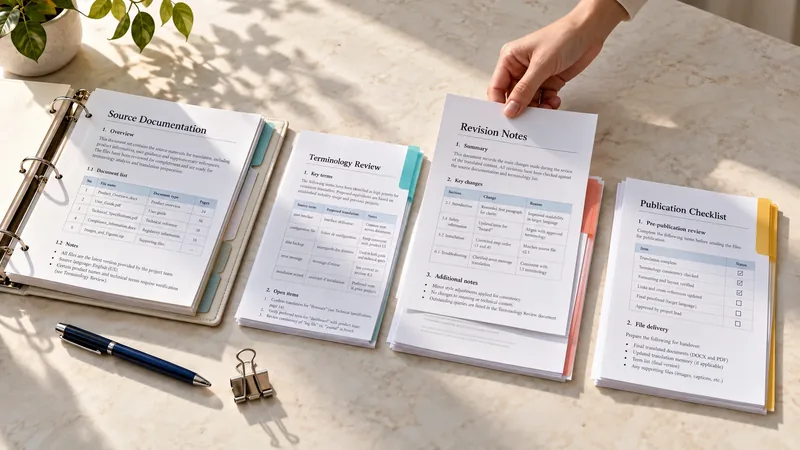
Human review should test the resolved meaning in each target language, not simply confirm that a sentence was edited. Ask the reviewer to check the action, timing, conditions, and exceptions against the approved answer. The client's technical reviewer confirms the scientific interpretation and any required content approval; the language reviewer checks that the translation expresses that interpretation accurately and clearly for its intended readers.
Agree on how the final handoff package will be distributed at the start of the project. Depending on the scope, the final package may contain the approved translations, a query register with approved answers, a source revision reference, and a file-by-file implementation record. A small project may use a concise spreadsheet; a larger controlled document set may require official records in the client's system. The deliverable is evidence that the decision reached the final content, not merely an inbox full of query answers.
- Every comprehension query has an approved resolution before the affected content is released as final.
- Each resolution identifies the source revision, authorized scope, and responsible content approver.
- All affected language versions are checked, with changes or justified no-revision decisions recorded.
- Related occurrences and reusable translation resources are assessed and modified as needed.
- Clean final files, review files, and outstanding work are clearly distinguished at handoff for distribution.
Plan Time for Answers, Not Just Volume
Query effort and time depends on source completeness, conflicting references, the number of decision owners, and whether answers arrive before or after translation and layout. Ask the provider to allow for query preparation, coordination, implementation, and review in the proposed scope. Establish response schedule checkpoints for questions delaying the translation process and a way to reassess delivery dates when source decisions change. No fixed turnaround schedule can be inferred from word count alone.
If an approved answer changes the content after language translation is complete, treat it as a controlled change with an impact assessment. Identify delivered files, work in progress, and downstream materials that may also need revision. The client determines whether earlier releases require action through their own document-control process. The translation team should assist with reporting the affected language work and versions without assuming authority to withdraw, amend, or approve client materials.
Frequently Asked Questions
Does Every Clarification Affect the Source Document?
No. An owner may explain a reference that could be defined elsewhere in the approved source package. Record that explanation location and its basis. If the passage itself contains an error or remains misleading, the source owner should decide how to correct it under the applicable approval process. Translators should not simply rewrite controlled source content.
What if Only One Language Team Raises a Question?
Assess the source issue across all affected languages, regardless of which language team raised the question. Grammar can force one language to specify a subject or relationship that another language does not require. A single team's query may therefore expose a shared uncertainty. Other teams can confirm that their wording already reflects the approved meaning, but that conclusion should follow a confirmation check.
Can Email Serve as a Record of the Approved Answer?
It can, if the client's agreed upon process permits it, and the email sender has the appropriate authority. Link or transfer the answer into the query record with its date, scope, and approval status. A message without a clear decision or source reference is not enough to guide consistent implementation across multiple teams.
Discuss a Pharmaceutical Source Clarification Project
Terralíngua provides ISO certified translation and localization for pharmaceutical and life sciences materials, including clinical reports, patient information, scientific documentation, and client-prepared submission materials. Our experienced approach matches subject matter specialist native-speaking linguists with industry best practices such as referring content questions to designated client reviewers. Clients can select either the ISO 17100 certified all human translation process or the industry AI with a human edit ISO 18587 method with extra review scopes and multilingual document formatting available.
For a query-intensive translation assignment, ensure to discuss project coordination in detail such as who should consolidate questions, how answers are designated as approved, and which resolution records should accompany the final delivery. The workflow described here provides a basis for that discussion; individual steps and deliverables should be confirmed in the scope. Please note that these translation and review recommendations support clear multilingual communication, but do not establish regulatory acceptance or replace client technical approval.
Pharmaceutical and Life Sciences Translation Services
Request an assessment with representative source files, target languages and markets, intended readers, required formats, and your required deadline. Include the controlling version, approved references, examples of how to resolve content questions, and the contacts authorized to answer scientific questions. Those inputs help define the translation process, human review steps, and the coordination needed to carry one approved content through the full language set.