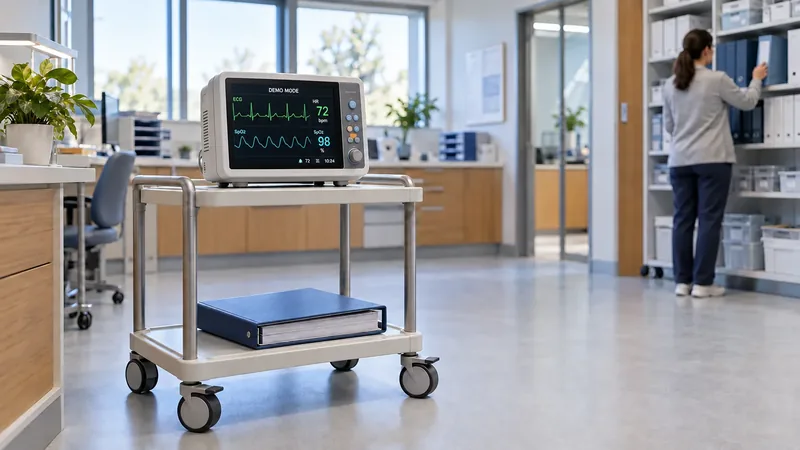
A medical device troubleshooting guide connects an observed problem with the manufacturer’s approved information about it. Translation must preserve that connection. A symptom description, displayed message, model limitation, and escalation instruction may occupy different parts of a page, but readers need to understand them together. Clear language is valuable only when it still describes the correct device and the authorized response.
Medical troubleshooting translation therefore requires more than a localized glossary of technical terms for a successful outcome. Documentation teams need approved service references, reliable device context, and qualified client reviewers who can resolve product questions. Terralíngua provides medical technical translation and multilingual desktop publishing for product documents. We work in partnership with our clients by supplying the localized language and layout work to support the manufacturer’s content; while our clients confirm the content’s applicable diagnosis, authorized repair process, and provide technical approval for any queries.
Terralíngua’s medical and dental translation services
Define the Reader and the Document’s Limits
Identify who is expected to use the guide before translation begins. A document for authorized service personnel may assume knowledge, access, and responsibilities that an operator does not have. A distributor’s support reference may serve an entirely different purpose. The same device terminology can appear in all three, but that does not make the instructions interchangeable.
State whether the assignment covers an operator troubleshooting section, a service reference, a support knowledge article, or a combination of controlled documents. Explain how each relates to the current instructions for use. Do not blend passages intended for different audiences into a single translated guide merely because they concern the same content. The client must approve the translation scope and any distinction between what readers may identify, report, or act on.
The U.S. Food and Drug Administration’s (FDA) human factors material considers device users, use environments, and how content interfaces together; including operating instructions among the elements through which people interact with a device. This provides useful context for planning the translation. It is not a universal language checklist or evidence that a translated guide has passed usability evaluation. The manufacturer determines the applicable product and market requirements.
FDA background on medical device human factors considerations
Build an Approved Reference Set for Medical Troubleshooting Translation
Provide your translation partner with the governing source guide and identify its authorized revision number or date. Add the approved references needed to interpret the content, while distinguishing reference-only material from that which must be translated. An older service manual may help explain terminology, but it should not automatically override the current source. If two supplied documents disagree, the client’s technical content owner must decide which statement governs the translated version.
- Current source files and a reference PDF showing the approved layout.
- Device models, configurations, software versions, and markets covered by the guide.
- Approved message lists, screenshots, control labels, and relevant illustration files.
- Current instructions for use and authorized service references needed for context.
- Terminology, earlier approved translations, and instructions for preserving identifiers.
- Named technical and regulatory reviewers, required outputs, and release schedule.
Assign a status to each reference: current and authoritative, current but contextual, or superseded and supplied for comparison. Record that distinction where the language team can easily identify it. File names such as “latest” are not enough when several departments supply different copies. An approved revision reference code helps prevent a translation deliverable from being based on an incorrect source.
Where access is restricted, agree on an appropriate review process or select a representative set of approved screenshots for the scope of work. Remove unnecessary information such as personal or privacy related content from any supplied examples. Provide translators usable device context without relying on informal photographs, undocumented support conversations, or assumptions about how a particular product behaves.
Preserve the Difference Between a Symptom and a Cause
Troubleshooting content should distinguish an observed condition from a possible cause. Ensure that distinction carries over to the translated content. A source phrase describing an intermittent display condition should not become a diagnosis of a failed component. Similarly, “may indicate” should not become “indicates” simply because the shorter sentence sounds more direct. Changes in certainty can change how the reader interprets the guide.
Ask the client to clarify compressed descriptions that could have several meanings. Words such as “blank”, “inactive”, “unavailable”, and “unresponsive” may describe different observations. A screenshot can visualize a user experience, but may not establish the underlying state. The translator should use the client approved reference material for context to select appropriate terminology and raise a client query where the source remains ambiguous.
Preserve timing and conditions as well as nouns. “During startup” and “after startup” refer to different situations. “Occurs continuously” and “occurs intermittently” should not be treated as stylistic alternatives. These distinctions belong in the terminology and review process when they help readers locate the applicable entry. No new symptom interpretation or corrective action should be introduced as an editorial improvement.
Check Device Error Message Consistency Against the Display
A troubleshooting entry may quote an exact device message, explain it, and identify a reference code. Determine which elements readers will see on the device. If the interface remains in English, a translated guide may need to retain the English displayed wording alongside a translated explanation, using client-approved style conventions. Replacing screen text with a translated version could make it difficult to locate needed information.
If localized device messages or screen shots exist, insert these images and approved messages for the relevant release. Device error message consistency means matching the product, not producing an independent translation of the same string in every document. If a supplied translation appears unclear, record the issue and request a content owner’s decision. A document translator should not be instructed to localize a message that remains unchanged in the device interface.
Protect error codes, model identifiers, and other fixed references. Preserve letters, digits, punctuation, and leading zeros according to the client’s style guidelines. Similar-looking codes may represent different entries. Also distinguish a message’s wording from its severity or classification: the language team should not change an escalation level such as translating a notice as an alarm, or soften an alarm’s meaning, without a corresponding authorized source change.
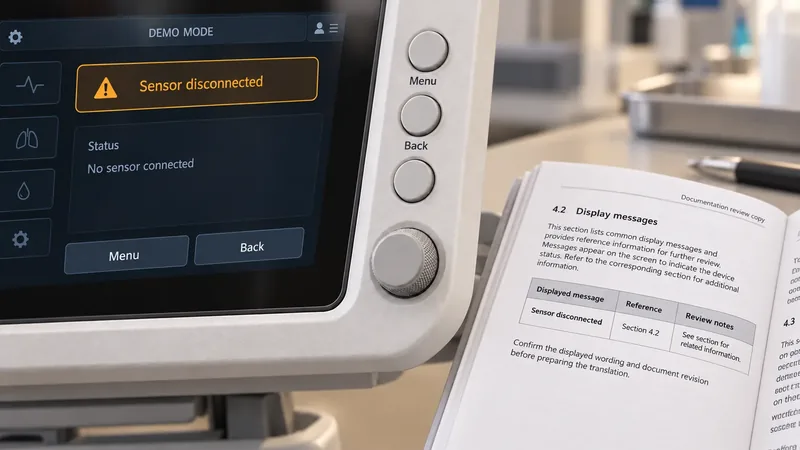
Provide context for references to physical controls and on-screen commands. Confirm whether a guide names a button, a menu item, or a status indicator. Photographs and approved screenshots should help distinguish them. Translated captions and callouts should preserve source content relationships, while the client should confirm if the image and wording correspond to the intended device configuration.
Keep Model and Version Applicability Visible
A troubleshooting guide may cover several devices that look alike but have different messages, accessories, or approved references. Make the applicability of each specific. Model names, software versions, configuration restrictions, and document revisions should remain attached to the content they qualify, including when translated text modifies pagination or table height.
Consider this fictional documentation example. An entry for code applies to model with one software version number and also refers authorized readers to a related section of an approved service document. Another model uses the same code with a different reference. The translator must preserve each version and model’s association. The matching code does not justify merging entries or applying one reference to both devices.
The client content owner should resolve ranges and exclusions that are unclear in the source. A phrase such as “from version 3.2” may need confirmation about how to access other versions or specific configurations. Do not turn a narrowly applied statement into “all models” version for simplicity. Where applicability is defined elsewhere, preserve the cross-reference and make sure the destination remains identifiable in the localized edition.
Include the appropriate screenshots for each version when their differences matter. A familiar image from a previous release can be misleading if a control or message has changed. The client content owner should confirm image applicability; while the production team should verify that the approved image, caption, and translated entry will stay connected in the final file.
Translate Escalation Instructions Without Expanding Authority
Escalation wording defines what happens when the reader reaches the limit of the guide. Preserve the correct point of contact while considering different locales, when the instruction applies, and any stated restriction on further action. “Contact authorized service” should not become a general invitation to seek any repair provider if the source specifies an authorized role. Localization includes retaining appropriate boundaries.
Confirm the meaning of organizational terms such as “technical support”, “biomedical engineering”, “distributor support”, and “authorized service personnel”. These roles are not automatically equivalent across markets or institutions. The client should approve the intended destination and its localized established name. Translators should not substitute a more familiar local role term without client confirmation.
Check escalation links and contact details against the approved market-specific source. A generic support homepage may not be an adequate substitute for a designated procedure or portal. Identify whether the intended reader can access the destination and whether the linked material exists in the required language. Where it does not, the owner should approve the substitution rather than allowing an assumed URL or unsupported localized content to enter the guide.
Preserve the source’s sequence and limiting conditions. Do not expect the translator to add steps such as restarting, resetting, or adjusting equipment information. These items are product decisions, not language decisions. If the source leaves the next step unclear, the translator should request clarification and record the client approved answer before completing the affected passage.
Maintain the Logic of Tables and Decision Paths
Troubleshooting information often appears in a table or a branching diagram. Translation must preserve the association between a condition, its explanation, and the applicable reference or escalation instructions. A row break that moves a qualification beside the wrong entry can change meaning even when every sentence has been translated correctly.
In a decision path, check the wording attached to each branch and where it leads. A negative condition must not become positive along the chain, and “if” must not become “when” changing the source’s meaning. Keep repeated labels consistent, but do not collapse separate branches merely because their translated text looks similar. Technical client reviewers should confirm the logic; while translation provider layout specialists preserve its presentation.
Multilingual layouts may require wider columns, additional space, or a different page break with the consideration of translated text expansion or contraction. Repeated table headings and clear continuation references can help maintain orientation. Avoid shortening conditions or reducing text to an unreadable size just to preserve the original page count. If wording changes during the formatting process, ensure it is returned for a native speaker language review and, when meaning is affected, qualified client approval.
Multilingual desktop publishing for translated technical documents
Inspect the final PDF or other agreed output, not only the editable source. Check complete text, readable codes, figure references, bookmarks, and hyperlinks where included. For right-to-left languages, review mixed-direction identifiers and table flows without automatically mirroring a device image or accidentally altering the technical relationships. Visual correctness and technical correctness require different checks.
Organize Service Guide Language Review Around Approved Decisions
An organized service guide language review assigns specific issues and decisions to the right owner. Linguists check meaning, terminology, completeness, and clarity against the approved source. Production reviewers check layout and navigation. Qualified client specialists resolve technical questions, approve safety-sensitive wording, and confirm applicability. Regulatory reviewers determine any market-specific requirements within their responsibility.
Use a query log with the document revision, section or entry identifier, source wording, question, and proposed language where appropriate. Record the authorized answer and the affected editions. “Please confirm” is not as helpful as a precise question explaining whether the ambiguity concerns a symptom, a model restriction, a displayed message, or an escalation role.
For the fictional entry example above, a review can trace the code from the approved message list to the relevant model entry, then to the cited service section. The qualified reviewer confirms the reference is applicable. The language reviewer checks that the model restriction and referral remain intact. The production reviewer checks that the final link and page presentation point to the intended destination.
Agree how conflicting review comments will be resolved. A regional reviewer may prefer a familiar term, while the product team requires a particular approved designation. The project owner should consolidate the comments into an approved decision and explain its scope. Applying incompatible comments independently across languages makes a controlled guide harder to maintain and can obscure which wording was approved.
Agree on Translation Deliverables and Acceptance Criteria
Delivery may include localized editable files, formatted PDFs, an approved terminology list, and the resolved query record. Specify whether linked documents, screenshots, or embedded graphics are included. If the output will enter a document-management system, confirm the required naming, metadata, and submission responsibilities before production. Translation delivery should not be confused with authorization to release the document.
- Content: all in-scope entries are present, and uncertainty, restrictions, and escalation conditions retain their approved meaning.
- References: protected identifiers and model associations match the governing source; cross-references and links lead to approved destinations.
- Presentation: no clipped text, detached qualifications, misleading row associations, or unreadable labels remain in the agreed outputs.
- Review: product questions are resolved by the designated owners, and the required client approvals are recorded.
- Version control: each language edition identifies the source revision from which it was prepared.
The required timeframe depends on the number of unique device contexts as well as the word count. Dense tables, multiple software versions, embedded text, and unresolved references can require additional preparation and review. Supply a representative complex section for a translation test and review assessment. Include sufficient time to receive client answers, check a formatted review, and incorporate approved feedback rather than treating review as an optional task after delivery.
When the source changes during translation, specifically identify the affected entries and references. A changed code or model limitation can significantly matter, even when the surrounding prose is unchanged. Evaluate the impact across languages and final formats, then confirm which versions are current and approved. The client’s document-control process governs approval and release; these project recommendations should not replace this process.
Frequently Asked Questions
Can an Operator Guide and a Service Guide Share Translations?
Approved terminology may be reusable, but complete passages need review for audience, authority, and context. A service instruction should not be transferred into an operator guide merely because the device or symptom is the same. The client must confirm that the content is appropriate for each reader.
What If the Device Display Is Not Localized?
Establish an approved style as to how the guide should display message text as well as provide a translated explanation. Supply the exact approved localized messages and screenshots. Retaining identifiable display wording may help readers find the correct entry, but the presentation convention should be approved by the product team.
Can Translation Proceed with an Unresolved Technical Question?
Unaffected sections may proceed if the translation provider confirms the project plan will permit this exclusion, while the disputed entry should remain clearly tracked. Do not release provisional wording as approved content. The client content specialist responsible should resolve any questionable areas and confirm the effect on related entries before final approval.
Prepare a Medical Device Troubleshooting Translation Brief
Terralíngua’s medical translation services cover product documentation using approved client references and terminology, with multilingual layout available in any format. For a troubleshooting guide, discuss language and formatting together during the quotation period and identify qualified client reviewers from the outset. Technical meaning, product applicability, and safety-sensitive instructions remain subject to their approval.
Send the final approved source guide or a representative sample for a test, its matching service references, device and software versions, target languages, intended readers, and required formats. Include the source revision, review contacts, and deadline. These inputs allow the project to be assessed around the actual document relationships, with clear responsibility for language work, layout, and client approval.
Request a quote for medical technical translation and multilingual layout