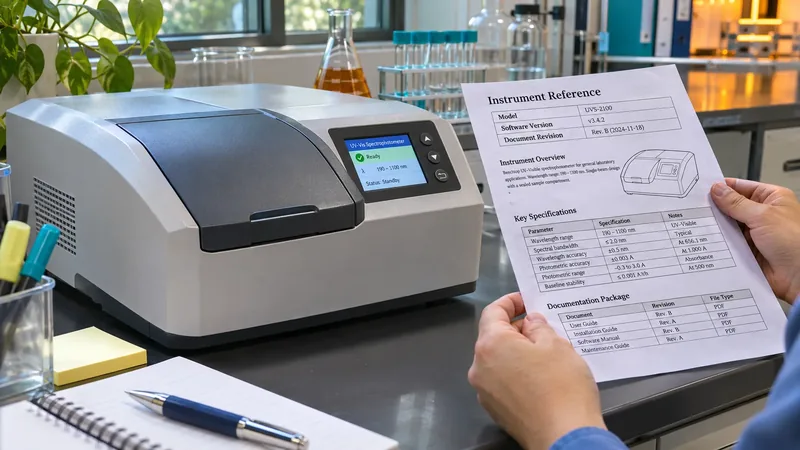
A laboratory manual can be linguistically fluent and still have user compatibility issues, such as an unavailable menu option. The problem may begin before translation: an outdated screenshot, an accessory described as standard equipment, or instructions copied from a different software release. Laboratory instrument documentation translation therefore starts with establishing exactly which product, configuration, and approved source that will be the basis for translation work.
For manufacturers, distributors, and laboratory organizations commissioning multilingual manuals, preparation means connecting words to identifiable equipment and intended users. It also means separating manufacturer instructions from local procedures. This article explains how to assemble that information, resolve language questions, and define usable deliverables. Terralíngua provides ISO certified quality technical and scientific translation and document formatting; while the manufacturer and designated client reviewers remain responsible for technical accuracy, authorized use, and any applicable regulatory decisions.
Define the Instrument Documentation Translation Scope
Begin with an approved document register rather than a folder labeled “latest manuals.” For each item, record the document identifier, revision, source language, owner, approval status, instrument model, applicable accessories, and software or firmware reference. Software controls the user interface and related functions; firmware is software embedded in the instrument itself. If the versions will affect the content, record the differences separately instead of using one ambiguous version field that will not apply to all.
The connection between documentation and software is visible in manufacturers’ own libraries. Agilent’s Automation Solutions guide index, for example, lists product, document title, and software version together. That is a useful illustration of the information a translation package should preserve, rather than evidence that one guide applies to every installation. Obtain the manufacturer-approved current source version for the equipment and release covered by your translation project.
Agilent Automation Solutions: Product Guides and Software Versions
Define the boundaries of the translation assignment. An operator manual, installation guide, quick reference, software help file, and service manual may belong to the same product family without sharing the same audience or authorization. State which documents will be translated, which are reference only, and which are outside the scope. Where several models share chapters, identify the specific exceptions so that common wording does not conceal a model-specific difference.
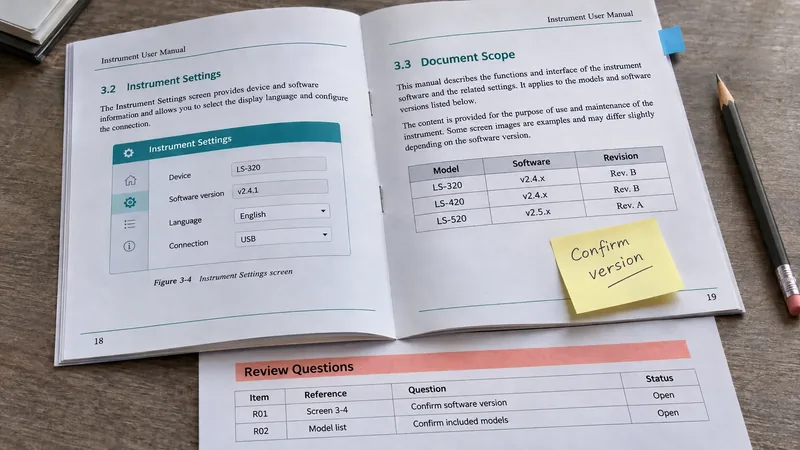
For example, imagine two fictional models that share a manual but use different software releases. A simple applicability matrix can connect each model to its installed options, software version, manual revision, and required language. One row might identify a basic configuration with an English-only interface; another might identify an optional module with approved localized screens. The point is not to create another technical specification. It is to show the assigned language team which combination each deliverable must describe and who has confirmed that relationship.
Identify Who Will Use Each Document
“Laboratory users” is too broad to guide many language decisions. A trained operator, laboratory supervisor, software administrator, and authorized service technician may need different information from the same product documentation. Identify the intended reader for each deliverable, including assumed familiarity with the instrument and the language of its interface. Do not simplify a technical distinction merely because the target audience includes readers who use an additional language.
Explain whether the translated manual will accompany equipment at a particular site, support a distributor, or serve several markets. Specify language and regional variety, not just country. A distributor’s preferred vocabulary can be useful, but it should not override the manufacturer’s component names. Where terminology differs between local practice and the approved manual, assign someone with authority to decide how that difference should be handled and make a record of those decisions.
Separate local laboratory procedures from manufacturer content. Though a site may have its own document describing responsibilities or recordkeeping; that does not make it an approved replacement for the instrument manual. If both are in the project, label their ownership and purpose. Translators should be able to recognize which statements describe the product, and which belong to the client’s local process, without inferring that relationship from file names.
Supply an Approved and Reproducible Source Package
Provide editable manufacturer files where available, together with an approved reference PDF. The PDF establishes what the released document looks like; while the editable files support translation and layout work. Include linked illustrations, fonts where sharing is permitted, templates, and any instructions needed to reproduce the output. For structured authoring, supply the relevant topics, reused text, and publishing configuration rather than an incomplete selection of pages.
- Identify the approved revision and distinguish it from working drafts or superseded copies.
- Supply screenshots from the applicable software build, with the interface language identified.
- Include editable diagram labels or a separate, clearly mapped text list for each figure.
- Provide existing approved translations and terminology, noting the releases they cover.
- List required outputs, target languages, review owners, and the intended delivery date.
Check the source package files to ensure they will create the final output and match the reference document. Missing linked graphics, substituted fonts, or hidden conditional content can create differences even before translation occurs. For a family of instruments, include an output example for each configuration in scope. A source content owner should resolve discrepancies between the editable material and the approved PDF; the translation team should not choose which version appears more complete.
If only a PDF or scan exists, request a recreation assessment before committing to a production schedule. Text extraction and reconstruction may be necessary, and diagrams can contain text that is not readily editable. Prioritize the time to obtain better originals for dense labels, unusual symbols, or poor scans. Keep recreated text traceable to the source, and have uncertain characters confirmed rather than guessed from context.
Build Instrument-Specific Terminology with Context
A glossary is very useful when it distinguishes concepts other than simply pairing words. Terms such as “cell,” “channel,” “baseline,” or “run” can mean different things depending on the instrument and sentence. Record a short definition, an example, the relevant component or screen, and an approved target term where one exists. Include a photograph or figure reference when it clarifies which physical part the word identifies.
Identify text that must remain unchanged: model identifiers, part numbers, file extensions, software commands, and other exact references. Not every capitalized phrase is a protected product name, and not every familiar English word should be translated. Establish the style guide rule set with the manufacturer or product owner. If an English label remains physically printed on the instrument, agree how the translation will help readers recognize it without assuming the label itself must change.
Consider this fictional example: a source uses “sample holder” in the overview and “cell holder” in a maintenance description. They might name the same assembly, or two different parts. The translator should raise a focused query citing both locations and the relevant illustration. The responsible technical reviewer confirms the relationship; the resulting terminology decision is then applied to all affected passages and recorded, including figure captions and index entries.
Match Software References to What Users See
Manual localization and interface localization are related but separate tasks. Establish whether users will see an English interface, a translated interface, or a mixture. When an approved localized interface exists, request its released labels or reference screenshots. Translating menu names independently can create plausible wording that does not match the product. Where labels remain in English, agree on a consistent convention for retaining the exact label and providing an explanation if needed.
Supply screen context with the isolated strings. A short label may be a button, a status, a command, or a field name. Record the navigation path and any relevant user-role or configuration differences. If a screen is available only with an optional module, make that limitation visible in the source. A screenshot should not imply that every reader can access a function that may belong to a different version.
Protect required literal inputs such as file names and command syntax from the process of ordinary language editing. Distinguish explanatory examples from values readers are expected to enter. Regional punctuation may be appropriate in prose while software may require a particular decimal separator or date format. The software owner should confirm such behavior. Translation preparation identifies these questions; however, it does not establish how an untested application will interpret an entry.
Preserve Maintenance Description Boundaries
Maintenance text needs particular attention as to who performs an action, under what conditions, and with which limitations. Language translation preparation should preserve distinctions between an operator’s assigned tasks and work reserved for authorized service personnel. Do not replace a specific role with a general “you” merely to make the prose more conversational. If the source does not identify the responsible role, ask the owner to clarify it before translation proceeds.
Check that conditions, intervals, exceptions, and references remain attached to the action they qualify. A note separated from its paragraph during file conversion can become difficult to interpret. Repeated passages should be compared in context: as a similar sentence under a different heading may apply to a different assembly or configuration. The project brief should identify safety-related content requiring the client’s designated review, without asking translators to reassess the underlying procedure.
Do not introduce cleaning methods, replacement intervals, materials, or troubleshooting actions that the approved source does not provide. If an instruction appears incomplete or inconsistent, document the question and obtain an authorized answer. Any technical correction should be reflected in the controlled source or an approved change record, not exist only in one translation. That keeps language work from becoming an undocumented revision of the instrument instructions.
Keep References Usable in the Formatted Manual
Instrument user references depend on navigation as well as wording. Readers need to connect a component name to a diagram, a table entry to its heading, and a cross-reference to the correct section. Plan document formatting as a defined deliverable. Specify whether the project includes editable files, screen PDFs, print-ready output, or help content, and identify any accessibility or publishing requirements that need separate assessment.
Review translated text in its final context. Longer labels may require adjustments to figure callouts or column widths; shrinking everything is rarely a satisfactory solution. Check that captions identify the correct figures, tables retain their row relationships, and warnings remain associated with the relevant material. Rebuild and test navigation after the pagination changes. Do not treat a visually similar PDF as proof that every reference still leads to the intended destination.
Give numerical content its own style rules. Preserve the source relationship between a value, unit, tolerance, and footnote, and flag ambiguous notation for confirmation. A language convention does not authorize conversion of a manufacturer specification. Where the client requests alternate units, the technical content owner should supply or approve the values and rounding rules. During formatting, compare complete table entries rather than checking numbers independently of their headings; as the correct value in the wrong row is still an incorrect reference.
Assign Review Decisions and Acceptance Criteria
Agree on review responsibilities and roles before files circulate. Linguistic review addresses meaning, terminology, and readability. Production review checks the document’s presentation and functioning references. The client’s qualified technical reviewers confirm instrument applicability, manufacturer-approved content, and unresolved product questions. Where regulatory review is required, it remains with the appropriate client specialists. These responsibilities should be specifically defined, even when one person participates in more than one review stage.
Use a consolidated query and feedback record with a document location, issue, proposed interpretation where appropriate, decision owner, and final guiding decision. Classify feedback so that a translation error, preferred wording, source correction, and new product change do not become indistinguishable edits. If reviewers disagree, determine a final decisionmaker. Sending conflicting annotated PDFs to the language team creates uncertainty about which instructions are authoritative.
- The delivered language and document identifiers match the agreed scope and revisions.
- Approved terminology, protected identifiers, and interface references are consistently applied.
- All in-scope text, including captions and diagram labels, are included.
- Queries affecting technical meaning have authorized resolutions or a clearly documented release hold.
- Formatted files have no missing text, broken characters, or incorrect figure and table associations.
- The designated client reviewer has completed the agreed technical acceptance process.
Evaluate these criteria on a representative section early. Choose material containing a screen reference, a technical illustration, and a maintenance passage rather than only the introductory pages. A small sample can reveal missing inputs and disagreements about terminology before they spread through multiple languages. Check what the sample review has assessed; however, it should not be interpreted as blanket approval of sections that have not yet been reviewed.
Plan Effort Around Versions, Assets, and Updates
Word count is only one planning input. A short manual with multiple embedded labels and screenshots may require more production work than a longer, cleanly structured document. Other evaluation drivers include the number of configurations, quality of previous translations, availability of technical answers, target audience writing systems, and client review rounds. Provide representative files when requesting an estimate so that translation, reconstruction, formatting, and client review can be considered.
For updates, send the final approved source and the previously released version, with the changes clearly marked. Identify whether a change affects a component name, software screen, model applicability, or only editorial wording. Reusable translation is a resource, not automatic approval: an unchanged sentence can acquire a different meaning when its surrounding conditions change. Review the affected context and linked references, not just the highlighted words.
Define how and who should manage source content changes. Set an agreed source, deliberately assign new revisions, and keep superseded packages separate. Maintain a record linking each translated release to its source and applicable product versions. This makes the next laboratory manual localization project easier to scope and helps prevent a distributor or internal team from selecting an outdated file.
Prepare a Focused Project Assessment with Terralíngua
Terralíngua’s ISO certified professional language services include the translation of manuals, technical specifications, and scientific documentation, along with multilingual desktop publishing. Our document-formatting services cover translated publications for print and digital use, including recreation of material available only as PDFs or scans. For a laboratory instrument project, discuss the source package, terminology references, software context, and required outputs so that the scope reflects the material needed for release.
Terralíngua’s Multilingual Desktop Publishing Services
To request a translation assessment or quote, provide an approved manual or representative extract, editable files if available, instrument and software version references, target languages, intended users, output formats, and the required deadline. Identify client contacts who can answer manufacturer-specific questions and approve the final technical content. Those inputs support a meaningful discussion of translation and formatting requirements while keeping product decisions with the people authorized to make them.
Contact Terralíngua to Discuss Technical Translation and Document Formatting