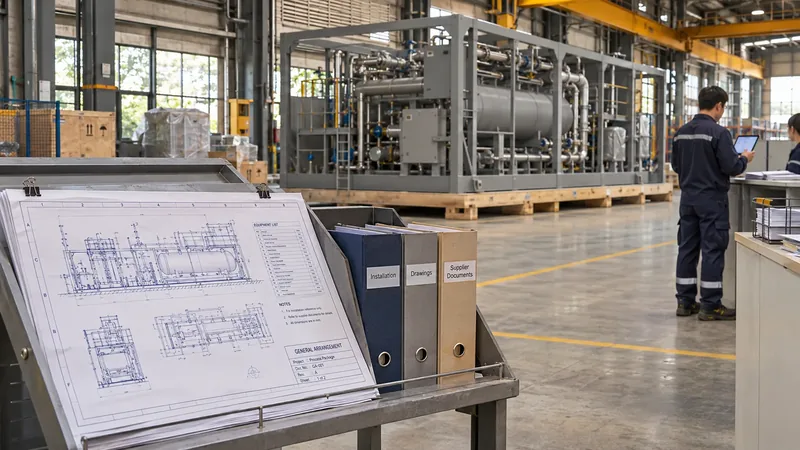
Consider this example - an installation instruction refers to a drawing. The drawing identifies a supplier component. The supplier manual could use a different name for that component, while the checklist cites an earlier drawing revision. Translating each file accurately will not, by itself, resolve these connection differences. Equipment installation document translation needs a package-level plan so that readers can move between documents without losing the reference, qualification, or responsibility that makes the information meaningful.
For equipment manufacturers, engineering contractors, and project owners, the first decision is what belongs in the language assignment package. Installation instructions, drawings, checklists, and supplier references may have different owners and release dates. This guide explains how to organize their translation, review, and formatted delivery. Terralíngua can support technical translation, document production, and project coordination; as engineering decisions and content authorization will remain with the responsible client technical parties.
Define the Installation Package Before Requesting Translation
Treat the package as a connected set of documents, not simply everything attached to a project email. Start with the equipment or project reference and identify the applicable configuration. Request equipment revisions, relevant serial-number ranges where applicable, and the engineering contacts authorized to confirm scope. A catalog description or equipment family name may not distinguish the specific arrangement being supplied to the site.
- Installation instructions: the approved narrative, its limitations, and references to supporting documents.
- Drawings: arrangement sheets, schematics, legends, and other drawings identified by the engineering owner.
- Checklists and forms: blank templates, field labels, response choices, and references to evidence or acceptance documents.
- Supplier references: applicable component manuals, supplements, and project-specific documentation.
- Package navigation: the index, document register, revision list, and any links connecting the files.
Not every item necessarily needs translation. Classify each item with a designation such as “translate”, “retain unchanged”, “reference only”, or “awaiting a decision”. Keep a record of the required language for each deliverable and identify existing supplier translations that may be suitable for reuse. This creates a visible scope boundary: for example, a “reference-only” manual can provide terminology support without becoming an unplanned part of the translation, and a drawing identifier can “remain unchanged” even when its descriptive title is localized.
Manufacturer documentation systems illustrate this package approach. The company SEW-EURODRIVE creates their documentation packages using the designations of “quotation”, “order”, or “project references”, with selections provided for document types, languages, and an interactive index. This is an example of organizing related documentation, not a prescription for every installation project. Your engineering content owner should determine which documents and revision identifiers to apply before the language team begins.
SEW-EURODRIVE: Compiling Project- and Order-Related Documentation
Map the Dependencies Between Documents
A document register tells you what exists. A dependency map tells you what each file relies on. This can be available in a practical spreadsheet without the need for a specialized system: simply record the source location, referenced document and revision, reference purpose, language treatment, and content owner. A reference might include identifying a component, directing the reader to a drawing note, or pointing to a separate acceptance form. These relationships will guide both translation queries and final checks.
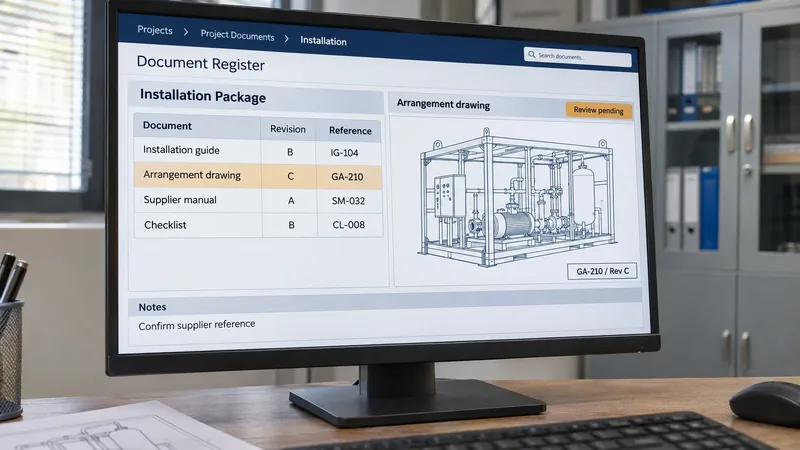
For example, consider this fictional package containing instruction IG-104, drawing GA-210, supplier manual SM-032, and checklist CL-008. The instructions name an assembly shown on GA-210, and the checklist asks the reader to record information defined in SM-032. If engineering replaces the assembly, the drawing may change. If this occurs, the translation coordinator needs the engineering owner to identify the affected related instruction and checklist passages, rather than assuming only the newly issued drawing needs attention.
Keep a reference record for the translator to maintain document consistency. A translated version document number can have different page numbers, a figure caption, or a hyperlink. Translated pagination can change, and a translated title may no longer match an English-only supplier file. Agree in advance whether references will retain the original title, add a translated description, or point to an approved localized equivalent. The reader of the localized version should be able to identify the actual destination, not just understand the translated words.
Missing dependencies should become specific questions before production. If an instruction points to an unavailable annex, ask whether it belongs in the translated delivery and who will supply it if it is required. Do not simply replace the reference with a convenient document found online. Similarly, an unresolved conflict between a drawing and a manual requires an engineering decision. A language provider can expose conflicts through content questions and track resolutions but should not decide which technical instruction takes precedence.
Request Source Files That Preserve the Package Structure
Supply the approved reference output together with its editable source files where available. Word-processing files, spreadsheets, desktop-publishing files, and drawing exports have different preparation needs. Include linked assets and identify text stored inside images or embedded objects. For drawings created in computer-aided design software, agree whether the task involves native drawing files, extracted text, or a separate translated annotation schedule. Do not assume every format can be edited in the same workflow.
An annotation schedule is a list that connects each translatable drawing note to a stable identifier or location. It can be useful when an engineering team must place approved wording back into its own drawing system. Establish who extracts the text, who reinserts it, and who verifies the resulting sheet. A translated list alone does not equate into a translated drawing, and a final PDF does not automatically provide an editable source for future changes.
Supplier files need similar attention. Confirm the needed permissions and responsibility for translation and ask whether an authorized language version already exists. Record the exact supplier reference and revision number rather than assuming a similarly titled download is correct. When a supplier document stays in its original language, decide how the package index will identify that limitation. Never present an English-only attachment as part of the translated delivery scope or package without the proper identification.
If only scans or flattened PDFs are available, have them assessed early for the required recreation time. Reconstruction may require source clarification, text recovery, and additional layout work. A blurred drawing note or uncertain character should be returned to the content owner for confirmation. The production staff should not infer dimensions or technical symbols from an indistinct image. The estimate should distinguish the translation assessment from the recreation or layout work needed to make the material usable for the final translated version.
Approve Terminology Across Equipment and Supplier Boundaries
Installation package localization often crosses several naming systems. The equipment manufacturer, integrator, component supplier, and receiving site may use different terms for the same item. Build a terminology record that connects the approved name to its equipment tag, drawing reference, definition, and source owner. Add approved target-language terms where available. This gives translators the needed evidence for choosing a term instead of relying on the most common industry dictionary equivalent.
Keep identifiers distinct from descriptions. Equipment tags, terminal designations, drawing numbers, and supplier part numbers may need to remain exactly as issued even when surrounding prose changes. Confirm the handling of abbreviations and physical labels with the engineering owner. Where a local nickname is useful, it can be recorded as a reference or an approved alternative; it should not simply replace the name used in the drawings.
Watch for ordinary words with technical consequences. “Verify,” “record,” and “approve” describe different responsibilities; as well as “provided by” may allocate a task or supply obligation. Ambiguous wording should trigger a focused query identifying the passage and the decision needed. The project owner should also establish how to resolve competing supplier terms. Enforcing one preferred word everywhere can be misleading when similar terms describe different components.
Preserve Conditions, Roles, and Checklist Meanings
The translation should preserve who acts, what the statement applies to, and any condition or exception attached to it. References to qualified personnel, supplier authorization, and prerequisite documents should not change during the language fluency editing step. If the source leaves the actor unclear, the translator should request clarification. The aim is to communicate the approved instructions faithfully, not to introduce a new installation sequence or decide which qualifications the project requires.
Checklists should be reviewed in the translation process. A field can request an observation, a recorded value, confirmation of completion, or approval by a designated party. Those meanings are not interchangeable. Consistently translate response options and preserve distinctions such as “not applicable” and “not checked.” For example, the engineering content owner should confirm any acceptance wording; as translators should not convert an open observation field into a pass/fail decision.
Define the treatment of numbers, units, symbols, and dates. The localization of explanatory text does not authorize the conversion of engineering values or tolerance revisions. If alternate units are requested, have the responsible technical party supply or approve the values and rounding. For fillable forms, confirm expected entry formats as well as the related visible labels. A reader may understand the translated field but still enter data in a format the receiving system cannot use.
Keep installation and commissioning documentation separate from other content such as operator-video training. Multilingual references may include approved forms and document links used by the project team; however, they do not establish that translation has been completed. A training video will have its own translation considerations such as the script, timing, and demonstration requirements. Translating either type of material does not replace the need for engineering supervision, competence requirements, or the client’s technical and regulatory acceptance process.
Schedule Translation Around Engineering Releases
An installation package may not become ready at the same time. Ask which documents are approved, which are still changing, and which depend on outstanding supplier information. Agree on a source baseline file set or an identified set of revisions authorized for language work. If translation must start before the whole package is ready, record the provisional material and its dependencies so that preliminary wording is not mistaken for a final release.
Plan batches around connected content, not only around file size. Translating an instruction before the terminology in its referenced drawings is resolved can create avoidable rework. For example, stable sections may proceed while a changing annex remains on hold, provided the relationships are clear. A delivery schedule should allow for engineering answers, linguistic review, layout, and package checks. The translation provider cannot properly evaluate the time required for unknown source changes and confirm a delivery date. Even if the equipment shipment date is fixed, adequate time must be allowed to complete the necessary quality steps.
For each change, supply the revised source and a concise explanation of what changed and where it should also be applied. Distinguish a corrected spelling from a changed component, responsibility, or document reference. The engineering owner identifies the technical impact; the language team assesses affected wording and production files. Reused translations should be checked against the new context rather than simply accepted because a sentence appears unchanged.
Establish the process for review items requiring technical answers and the consolidation of review comments. The assigned engineering content owner may need to obtain input from mechanical, electrical, or supplier specialists, and then supply the language team with one authorized decision for each issue. Record that answer with the relevant revision. This avoids parallel email discussions producing different translations of the same instruction and makes later update decisions easier to trace.
Review Layout and Navigation as Part of the Translation Delivery
A translated installation package must remain usable across its formats. Define whether delivery includes separate PDFs, editable files, a combined binder, fillable checklists, or a linked index. Establish the naming and folder conventions before production. If files will be opened without internet access, establish this as links to external portals are not equivalent to included reference files. Confirm how readers will identify the language and revision of each item.
Check drawing text at its intended viewing or print size, not only enlarged on a monitor. Longer translated text may need additional space, but layout changes must not obscure linework, disconnect callouts, or alter technical relationships. Where the drawing content owner controls the source layout decisions, provide translator placement direction for resolution issues. For forms, preserve space for responses and signatures rather than allowing longer translated labels to consume the areas needed for completion.
Package review should follow a real reference path. Open an instruction, locate the drawing it cites, match the component identifier, and find the associated checklist reference. Note that this is a document-navigation check, not a test of the equipment. Repeat these steps after files are renamed or combined. Verify bookmarks, links, attachment presence, and references affected by changed pagination, using the delivered folder structure rather than the production team’s internal paths.
Agree on Translation Acceptance Criteria
Set acceptance criteria before translation delivery so that each content reviewer knows what to assess. Linguistic reviewers check meaning and approved terminology; production reviewers check readability and document functioning. Client engineering reviewers confirm applicability, technical content, and decisions raised during translation. The project owner determines release authorization. A clean layout or completed language review is not evidence that the equipment or installation itself has been accepted.
- The delivery matches the agreed document register, languages, and equipment revisions.
- Each reference points to the intended document, drawing, annex, or approved external source.
- Protected identifiers and approved terminology remain consistent across the package.
- All scoped text is accounted for, including drawing notes, form options, and embedded labels.
- The intended formats work without missing assets, clipped text, or broken navigation.
- Unresolved technical queries are visible and handled according to the agreed release decision.
Ask reviewers to distinguish a translation correction from a source change or stylistic preference. A new engineering requirement should enter the controlled source process rather than being added only to one language. After corrections, issue a clear delivery record identifying replaced files and their revisions. Keep superseded material separate so that a recipient does not inadvertently combine an older drawing with today’s instruction.
A practical handoff can include a delivery manifest listing each translated file, its source revision, language, and associated reference files. Identify anything deliberately excluded, such as an untranslated supplier attachment, and record who accepted that scope decision. If the package is delivered in stages, state which items the current delivery replaces and which remain pending. This prevents a partial language delivery from appearing complete merely because its folder contains an index and a cover page.
When comparing translation proposals, check that they cover the same scope of work. Drawing-note extraction, supplier-file assessment, engineering-query coordination, and reinsertion into native layouts may be separate tasks that one may consider while the other does not. The translation process can also affect the turnaround time if one considered an adequate review process schedule and any linked documents, while the other only considered the source text volume. Agree on what should be evaluated and considered rather than relying on a simple word count.
Scope Your Translation, Layout, and Coordination Needs with Terralíngua
Terralíngua’s ISO certified professional translation services include technical manuals and specifications, multilingual document formatting, and coordinated language and production work. Our project teams coordinate your assignments, with dedicated project managers supporting time critical communication. For engineering documentation, discuss the consideration of the connected package process rather than requesting a price for isolated files. The preparation and review approach described in this article should be considered for the individual assignment; and it is not a claim that every project uses or requires an identical process.
Multilingual Document Formatting at Terralíngua
For an assessment or quote, send your document register with the final source or representative approved files, any equipment revisions, target languages, intended users, output formats, and the required delivery date. Include an engineering content contact and identify if there are any pending supplier documents or releases. These inputs help separate translation, layout, file preparation, and coordination needs which will help to set realistic expectations before work begins, and the final multilingual package easier to review.
Contact Terralíngua About Your Equipment Documentation Project