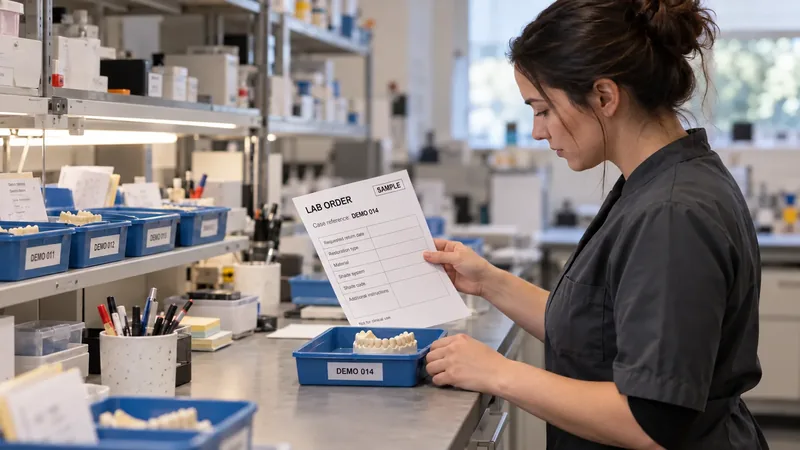
Dental laboratory form translation should prioritize preserving what each field specifically asks. A short label, a material option, or a note beside a checkbox can determine how a laboratory interprets a request. Translating those elements without understanding their purpose can produce correct wording yet still invite the wrong entry.
For dental groups, laboratories, and suppliers coordinating multilingual forms, the task combines specialist terminology with document layout. This guide focuses on preparing reusable order-form templates, their field options, and explanatory notes. It does not address making clinical prescriptions or approving an individual patient’s order. Terralíngua’s medical and dental translation and multilingual formatting services provide a relevant starting point for assessing the required language work.
Define the Laboratory Form Translation Scope
Start by describing who completes the form, who reads it, and how it connects the parties. A form completed by a dental professional and checked by a laboratory coordinator has different language needs from patient information. Identify the target countries and language variants, the receiving laboratory, and whether staff will confirm the translated form with the English source.
List every form variant in use, including separate sheets for different product categories, continuation pages, order amendments, and return instructions. Check whether a printed form and its digital equivalent ask the same questions. Older files may contain different options despite sharing a title. Select an approved source version rather than asking translators to decide which version governs the other.
Distinguish template translation from translating completed orders. The former covers labels, selectable choices, standard notes, and supporting instructions. Handwritten requests or free-text case comments are a separate assignment with different clarification and handling needs. Confirm whether applicable prescription wording, signatures, or other mandatory elements must be preserved; the client’s responsible reviewer determines those requirements for the intended jurisdiction.
Provide Approved Forms and Field Context
Send the editable source files together with a matching reference PDF. For a Word form, include the template and any protected sections; for a designed form, include linked assets and font information. If only a scan survives, identify that limitation before a translation estimate. Extraction and reconstruction need their own evalautions, particularly for small labels, punctuation, and closely spaced checkboxes.
An overall field inventory makes the translation assessment more useful than just providing a word list. Give each field a stable reference and record its visible label, purpose, permitted responses, any character limit, and its connection to nearby notes. Identify headings that apply to several fields. The translation team should be able to tell whether an empty area accepts a code, a date, a choice, or an explanation.
- Approved master form, revision identifier, and reference PDF
- Target languages, regional variants, intended users, and receiving laboratories
- Approved terminology, product references, abbreviations, and previous translations
- Field definitions, selectable options, conditional instructions, and protected identifiers
- Required editable, print, or digital outputs and relevant size constraints
- Named contacts for terminology decisions, form approval, and consolidated feedback
Use sample completed forms to explain how a field works. For the initial assessment, a blank template and test entries will often provide the necessary context without sharing sensitive patient records. If actual patient material is necessary for testing purposes, agree on access and handling before the document transfer and follow your organization’s information-protection procedures. Removing personal information alone should not be assumed to resolve every confidentiality concern.
Translate Field Labels According to Their Function
Short labels are often harder to translate than complete sentences. A word such as “return” could refer to a requested delivery date, a shipping destination, or an item being sent back. Ask the form owner to define the intended response. Where the source itself is unclear, resolve the source wording first and record the approved clarification for every language.
Consider a sample form that contains both a due date and an appointment date. The owner confirms that the first means the date the completed form should reach the practice; the second refers to the patient appointment. Translating both as a general completion date would erase the distinction a workflow needs. Clear source content definitions assist reviewers with evaluating target wording against the intended event.
Treat the response options as part of the heading label. An accurately translated heading can still fail the user if its choices are incomplete, reordered without approval, or separated from their boxes. Preserve distinctions among a required response, an optional comment, and an instruction that applies only after a particular selection. Do not add a default choice or interpret a blank space as a negative answer.
For multilingual lab order fields, separate visible patient wording from identifiers used to track the form. A reference such as a material selection may need to remain unchanged even when its display label is translated. Ask the system owner which identifiers should be protected. A translation package can document that distinction however the client must ensure the files will automatically connect to a laboratory management system.
Resolve Material Descriptions and Dental Form Terminology
Material descriptions should identify the approved choice at the level of detail the form requires. A broad category, a particular material, a product family, and a catalog reference are not interchangeable. Supply the laboratory’s current selection list and relevant manufacturer documentation. Do not replace an unfamiliar designation with a familiar local product or a broader term simply because it fits the available space.
Build a terminology record around consequential terms. Include the source wording, its meaning in this form, an approved target equivalent where available, and a reference or reviewer decision. Explain whether two similar labels represent different options or inconsistent naming. The laboratory or product owner must resolve that distinction before the language team standardizes it in the record.
Keep shade-system names and shade codes associated with one another. A label describing a shade can be translated, while the associated product designation or code may require exact preservation. Define which elements are fixed and how the form identifies the applicable system. Translation should not select a shade, infer an omitted system, or substitute an apparently equivalent code.
Collect separate abbreviations and ask for their approved expansions. Familiar shorthand within one laboratory may not be clear to another audience. Decide whether each abbreviation remains unchanged when localized, appears with an explanation, or has an approved equivalent. Apply that decision consistently to labels, option lists, instructions, and any accompanying guide; do not invent shorter abbreviations simply to solve a layout problem.
For unresolved terms, send a focused query to the appropriate content owner that shows the field in context, the possible interpretations, and the decision needed. For example, ask whether a shortened material label names a general category or a specific approved selection. Keep the answer with the established terminology record so that another reviewer does not reopen the same question later and create a different form variant.
Keep Tooth Notation Separate from Ordinary Numbers
Tooth identifiers need a specifically agreed treatment. The American Dental Association’s glossary distinguishes the Universal/National and ANSI/ADA/ISO tooth numbering systems. That distinction matters when a form crosses markets: a tooth reference is part of an identification scheme, not an ordinary number to be reformatted or translated.
American Dental Association: Glossary of Dental Terms
Identify the notation used in the approved source and the notation expected by the receiving laboratory. If a different scheme is needed, request separately approved mapping and qualified verification. The translator should not convert entries during translation without consulting the client. A clear system label may be useful, but adding one is a source-form change for the owner to approve.
Where the form includes an arch diagram be sure to verify how text, orientation labels, and entry spaces relate to it. A layout adapted for a different reading direction should not automatically mirror anatomical artwork. Flag any proposed repositioning that could change interpretation. The designated dental reviewer should confirm the representation and references in the finished form.
Preserve Units, Dates, and Qualifying Notes
Separate the meaning of a quantity from its presentation. Where the approved form asks for a measurement, keep its unit attached to the relevant field and preserve limits or qualifiers. National Institute of Standards and Technology’s (NIST) International System of Units (SI) guidance treats a quantity’s value as a number together with a unit and addresses spacing between them. Therefore losing a unit during layout is more than a cosmetic omission.
NIST: Rules and Style Conventions for Expressing Values of Quantities
Agree on decimal punctuation, date presentation, and any digital input constraints before applying language-wide formatting rules. A decimal convention may differ from what a particular field accepts. Unit conversion or rounding requires specific approval; neither should happen as routine language editing. If the source inconsistently combines a unit and a field label, raise the discrepancy rather than simply correcting it.
Explanatory notes deserve the same attention as headings. Wording such as “if applicable”, “select one”, or “attach the referenced file” changes how the form is completed. Keep conditions beside the fields they govern. If a note refers to another section or attachment, verify that the reference still works after translation insertion and page reflow.
Treat references to attachments as part of the scope. A note asking for a photograph or a supporting file should identify what the user is expected to supply without introducing a new clinical requirement. If the approved instructions distinguish an optional attachment from a required one, preserve that difference. Check that attachment names match any separate upload section labels or printed checklists.
Make the Translated Form Usable
Plan for translated labels that occupy more space with text expansion. A short English term may need several more characters or words in another language. Allow rows or label areas to grow while protecting the space needed for an answer. Reducing every font to preserve the original page count can leave a technically complete form difficult to use. Agree on any acceptable layout changes or localization modifications before production.
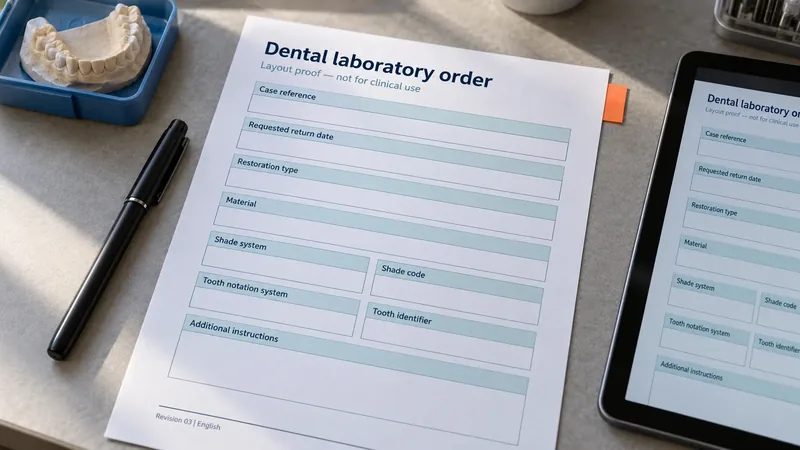
Check the relationship between every label, box, and option in the formatted file. A line break can make a qualifier appear to belong to the next field; a checkbox can drift away from its description. Bilingual forms require particular care because two languages compete for the same space. Confirm whether users need both languages on one sheet, or if it would be better to provide separate versions with matching field references.
Inspect a printed sample at the intended paper size and scale to experience it as a user. Check that text is legible, writing areas remain practical, and labels stay attached to their response spaces. If laboratories scan completed forms, review a representative scanned copy as well to ensure it is legible. The form’s formatting with shade rules, small footnotes, and color-dependent distinctions may become difficult to interpret after reproduction.
Specify Editable, Print, and Interactive Outputs Separately
Editable file delivery means specifying the authoring format and supporting assets to support later update needs. A PDF that displays correctly is not necessarily a maintainable source file for future modifications. Agree whether delivery includes the editable form, a reference PDF, and an approved terminology record. Printer-specific requirements should be supplied before the final export, not after translation approval.
An interactive PDF or online form can introduce additional behavior. Visible labels, help text, option lists, and error messages may all need translation, while field names and stored values may need preservation. Specifically define those components. The client’s application owner should test entry, saving, reopening, printing, and any downstream handling in the intended environment.
Do not treat a visually correct form as proof of accessibility or software compatibility. Reading order, field descriptions, keyboard operation, and other accessibility requirements need their own established checks. Similarly, importing translated labels into a portal is implementation work that must be scoped with its technical owner. Language and layout delivery alone do not establish that those functions will work after translation is complete.
Agree on Review Roles and Acceptance Criteria
Assign different questions to the appropriate content reviewers. Linguistic review addresses meaning, clarity, and consistent terminology. A qualified dental or laboratory reviewer confirms specialized distinctions and the intended request. The form owner approves field structure and source changes; the production reviewer checks the final layout. Where legal or regulatory review applies, identify that responsibility before release.
Run a pilot form completion exercise using representative entries, including long text and fields that trigger additional instructions. Ask a target-language user to complete the form and the receiving reviewer to explain what it requests. Resolve ambiguous wording before approving the final file. This is a practical document check, not a claim of clinical validation.
- Confirm every approved field, option, note, and page is present, with no unintended additions.
- Ensure terminology matches the agreed references; protected codes and identifiers remain intact.
- Check tooth notation and any approved adaptations, completed by the responsible reviewer.
- Units, dates, conditions, and cross-references retain their intended meaning.
- Labels, checkboxes, and response areas remain correctly associated in the final format.
- Requested file formats open correctly, and the client has completed any necessary functional checks.
- Comments are resolved and the approved language, revision, and source version are identifiable.
Control Revisions and Workload Plan
Word count alone does not capture the scope of work involved with lab forms. Many short labels, restricted spaces, multiple variants, ambiguous abbreviations, and missing editable files can require substantial preparation and time. Reviewer availability also affects the schedule. A representative sample, an acceptable term variant inventory, and clear delivery requirements support the creation of a useful scope assessment rather than relying on a word or page count alone.
Keep a record of source content changes and their effect on each language. A new material option may affect a dropdown, a printed checkbox list, and a note in the completion guide. Confirm whether the change applies to every form variant. Return the consolidated review comments to apply against one identified version but retain the information with the approved source and target files together for subsequent updates.
At project handoff, distinguish review proofs from files authorized for use. Identify the language and final version in an agreed location and remove obsolete proofs from the release package. If local teams need to edit the form later, agree who may approve those changes and how the master terminology will be updated. This helps prevent locally altered copies from becoming competing source versions.
Frequently Asked Questions
Can Translation Start from a Scanned Order Form?
A scan can be initially assessed, but its text and layout may need reconstruction before translation. Supply the clearest copy, confirm the approved revision, and identify any unclear marks or superseded entries. The client should verify the reconstructed source; optical character recognition outputs should not be treated as an approved transcription.
What If the Translated Label Does Not Fit?
First consider an approved layout adjustment. If shorter wording is necessary, have the language and dental reviewers confirm that it still requests the same information. Do not remove a qualifying word, merge distinct choices, or invent an abbreviation solely to preserve a box width.
Does Translating the Template Cover Future Completed Orders?
No. A translated template covers the agreed upon reusable wording. It does not consider any additional entries or any new handwritten or free-text later added to a form. Decide how those entries will be handled and who will clarify ambiguous requests. Any translation of actual case material also needs an appropriate information-handling arrangement.
Prepare Your Forms for a Translation Assessment
Terralíngua’s ISO certified medical and dental translation and localization services include subject matter specialist translation and document formatting, and multilingual desktop publishing which supports any editable files or exported PDFs. These capabilities are discussed with an agreed upon scope that is relevant to translating and implementing approved dental terminology and fitting the resulting language into usable order forms. Specific formats and review needs should be confirmed from representative samples.
Explore Terralíngua’s Medical and Dental ISO Certified Translation Services
To request an assessment, provide the approved master forms, preferred terminology references, required target languages, intended end users, and required outputs. Include any notation rules, space constraints, and deadlines, together with the assigned contacts who can clarify dental-content questions. This gives the project a defined starting point while preserving the client’s responsibility for clinical content and final authorization.
Request a Quote for Dental Laboratory Form Translation
Related Reading: Preparing Dental Product Instructions and Brochures for Translation