
A translation request can arrive from purchasing with one attachment, while the plant provided a revised copy, and a supplier has a file with comments based on an earlier version. Each sender may have a legitimate need regarding their file’s translation, yet the combined request leaves basic questions unanswered: which file should be considered the approved source content, who can approve changes, and which language version belongs at each site?
For manufacturing organizations, coordinating translation means connecting documents, decisions, and recipients before language work begins. Specifications, supplier forms, work instructions, and training materials need clear project goals. Terralíngua provides specialized manufacturing translation and project coordination, with portal access for requests, progress information, and completed files. Those services work best when the client defines the final source content and review responsibilities across the participating organizations.
Create an Approved Intake Record
A common intake record gives purchasing, documentation teams, and plant contacts the same description of the translation assignment. It does not have to be elaborate. Use a request identifier and a short scope statement covering the documents, intended use, languages, outputs, and deadline. Link each attachment to that record so that a file forwarded in an email does not cause confusion or create a second assignment.
Distinguish a request for a quotation from authorization to proceed. Purchasing may need an estimate before the final content is approved, or a site may want to confirm a delivery turnaround time while materials are still being prepared. Share the current content status with your translation provider and identify who will provide the final authorization to begin work. Advise your translation project manager before work proceeds if there was placeholder text in the quote that will be replaced. Confirm the delivery file formats required.
For example, a translation request might cover a supplier inspection form and the accompanying instructions for two plants. The form requires a return of editable translated files, while the instructions require both editable final files and PDFs. Naming those outputs at intake makes the request more efficient than asking for files after delivery that were not a part of the initial scope.
Separate Purchasing Authority from Content Ownership
The person placing an order may not be able to approve technical wording. Therefore, it is important to identify the content source owner: the person or function authorized to confirm translation queries. For supplier-authored material, establish whether questions go directly to the supplier or through the client's designated contact. Agree on the content owner and feedback method to avoid production interruption.
- Request coordinator: Collects the project requirements, communicates the agreed scope, and keeps participating sites informed.
- Purchasing contact: Confirms financial authorization and the payment method needed for the assignment.
- Source owner: Approves the source revision and resolves technical content questions.
- Language or site reviewer: Checks the translation against approved terminology and the intended local use.
- Release owner: Decides when the delivered material is approved and may enter the organization's distribution or operating process.
One person may hold several roles, but the decision-ownership should be established before work starts. A supplier's comment may explain a component without authorizing a change to the manufacturer's instruction. Likewise, a plant reviewer may know local terminology without having authority to change a specification. Determine the internal resource who will settle disagreements rather than expecting the translation provider to choose between competing technical instructions.
Provide an alternate contact for questions that cannot wait if the primary reviewer is not available. Give your reviewers a project schedule and include the relevant time zone and a realistic review window. For a project spanning several organizations, agree which questions can be answered locally, and which require central approval. This helps the project manager route an issue to someone who can resolve the issue, rather than repeatedly circulating the question.
Identify Approved Files and Their Relationships
Create an approved naming structure to identify the final files for translation, the reference documents, any earlier translations, and drafts copies. Keep a record of the document identifier, title, revision, source language, and applicable plant, process, or product. A filename containing “final” does not establish approval. Ask the source owner to confirm the approved governing version, especially when a supplier and a plant may have made modifications or revisions.
Provide editable source files where available, together with a reference PDF showing the final layout. Include linked illustrations, tables, and other assets needed for the deliverable. If only scans or flattened files exist, flag that limitation during the initial assessment. Text recovery or layout recreation can change the production scope and should not be discovered after a cost and delivery date have been approved. Confirm that the files may be released for the language work. If a supplier restricts access to certain drawings or specifications, discuss an authorized reference set and the handling requirements during the quoting process. Missing context should be identified early as well, rather than filled in through assumptions to meet a deadline.
Explain how related documents will be affected through the translation process. A requirement may appear in a supplier form, an instruction, and a training slide under slightly different wording. Identify shared references and intentional differences. Do not merge similar-looking files merely because their titles match; one may apply to another part, line, or customer requirement. The technical owner must confirm equivalence before translation reuse can be applied.
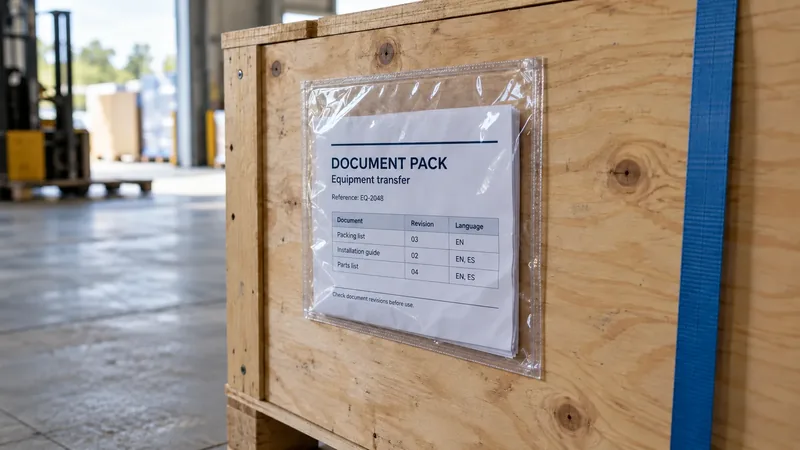
For documents accompanying equipment or materials, identify which item or package they concern and who will receive the translated version. A technically accurate translation attached to the wrong shipment or distributed to the wrong site does not fulfill the intended need. The translation handoff should preserve those associations, while your company retains the responsibility for its shipping and operational distribution decisions.
Map Languages to the Intended Audiences and Sites
Build a simple language matrix with one row for each required document and destination. Specify the target language and regional variant, the reader's role, and the required format. Do not infer language needs from a plant's country alone. Purchasing should confirm the intended audience with local contacts, including supplier teams or employees who may use another language to complete their work.
Separate language differences from process differences. Two plants may need the same language but different instructions because equipment or approved procedures differ. Conversely, one approved document may serve several sites without a technical change. Record those distinctions explicitly so that localization does not become an unauthorized rewrite of plant-specific content.
Provide terminology that connects local usage to the approved source. A component may have a familiar shop-floor nickname, a supplier designation, and a formal name in the specification. Ask the technical owner to confirm which name should appear in the documentation and whether an explanation is needed. Preserve part numbers and other identifiers as instructed; a translator should not replace them with a more familiar label without approval.
Earlier translations can help establish consistent wording but identify their status and applicability. An approved instruction from another site is not automatically suitable for a different configuration. Explain which terminology is shared and which exceptions are intentional. This allows the language team to reuse established material where appropriate while raising questions about content whose context has changed.
Turn a Complex Request into a Defined Assignment
Consider this illustrative scenario. Purchasing receives a supplier's revised acceptance checklist related to the source content, while two plants send comments on differing previous versions. One plant needs a translated checklist for supplier communication; the other also needs translated explanatory notes for its receiving team. The immediate task is to establish the approved source content and scope before asking for a firm translation quote and schedule.
- Confirm the source: The designated owner identifies the approved checklist revision and resolves conflicting comments.
- Separate the outputs: The coordinator provides the checklist and explanatory notes as distinct deliverables, with their destinations and languages.
- Supply context: The supplier contact provides approved definitions and references for ambiguous inspection terminology.
- Assign review: Each site names its reviewer, while one client contact consolidates comments affecting shared content.
- Define acceptance: The request identifies required formats, the review stage, and who authorizes distribution after delivery.
This approach gives the translation project manager a concrete assignment without asking the translation provider to settle inspection requirements. If a plant proposes changing an acceptance criterion during review, the source owner decides whether the change belongs in the current governing document or a future version. Only then can the team assess its effect on the other language versions and delivery dates.
Use Centralized Tools for Translation Project Coordination
Not all translation providers have a centralized translation management tool for your company’s coordination needs. Terralíngua's portal provides a central place to submit source materials for a quote, track project progress, review agreed pricing and delivery dates, and access completed translations. Users can complete current needs such as communicate with their assigned project manager as well as historical needs such as access to archived files. These functions support the practical exchange of project information. Portal access to Terralíngua's proprietary translation management tool and your secure silo is provided with no additional fee.
Review Terralíngua's client portal for translation requests and completed files
Establish authorized users with access to the translation management portal and determine how requests from different sites will be handled. Terralíngua has a human phone support available to answer access questions, as well as complimentary training if needed. Your company’s translation coordination plan should not assume that a supplier's system sends updates automatically, or that uploading a document constitutes formal technical approval – so ensure the process is understood. Your company’s existing approval and distribution processes still govern which materials are authorized for use.
Ensure instructions are included with any submitted files. Identify the source revision, reference-only attachments, target languages, reviewer contacts, and expected outputs in the quote request. If a file is replaced, notify the translation provider and describe what changed. A newly uploaded attachment without explanation leaves uncertainty about whether it adds to the assignment or supersedes a previously submitted file.
Consolidate Feedback Without Losing Local Context
Give each reviewer the approved source, relevant terminology, and the intended use of the translation. Define whether the review covers technical meaning, local terminology, formatting, or all three. A reviewer checking a supplier-facing form may have different concerns from someone reviewing a training handout. Clear instructions help distinguish a required correction from a preference that does not affect suitability.
Use a comment record that identifies the document, revision, language, location of the issue, proposed correction, and reason. Ask reviewers to distinguish source content concerns from translation issues. If a number or requirement is questioned, route it to the technical owner first before changing the translation. The source and all affected language versions may need an authorized update.
Included in the consolidated report should be the reasons for local exceptions. If two plants prefer different terms, determine whether they describe different equipment or simply use different vocabulary for the same item. An agreed shared industry term may be appropriate, or separate approved versions may be necessary. Record the decision and its scope so that future assignments do not reopen the same discussion.
Set a date to consolidate feedback and identify the technical owner. Ensure all relevant reviewers have responded. Silence from one plant should not be treated as approval unless the client has explicitly defined that no response equals approval. Terralíngua’s project manager can coordinate language questions and revisions within the agreed scope; the client's engineering, quality, or process specialists retain responsibility for technical approval and safety-sensitive content.
Handle Source Content Changes as Scope Decisions
When a supplier sends a text update during translation, explain whether it replaces the entire source or only selected content. Provide a change summary scope and the newly approved files. Ask the project manager to assess the effect on translation, review, layout, and delivery. A minor change repeated across several documents and languages could involve more time than its word count suggests.
Keep one clear instruction about which version supersedes past iterations. If work should pause for clarification, identify that section and who will supply the answer. Do not circulate different revision instructions to language reviewers and the translation team. The coordinator should ensure that each participant has the same information and is aware of the approved decisions.
For urgent needs, discuss whether a defined subset can be delivered first. Identify the documents and languages required for each stage and confirm that partial delivery will be useful to the receiving site. An early file may still require client approval before use. Avoid presenting a translation milestone as permission to proceed with a manufacturing or supplier activity.
Make File Verification Seamless
Agree on the delivery structure and approval process before production begins. Use a manifest, meaning a list of delivered files, that connects each output to its document identifier, source revision, target language, and destination. Define whether the package includes editable files, publication PDFs, or both. Where site-specific versions exist, distinguish them clearly so the recipient does not have to determine applicability solely from folder names.
Check the file acceptance against the approved work scope: every required language and document is present, the files open in the expected format, approved corrections are incorporated, and references and layouts remain usable. Identify any outstanding questions or exceptions. Technical acceptance and authorization for operational use belong to the client, even when the translation and formatting work has been completed.
Assign who will transfer completed files into the organization's approved distribution process. File availability alone does not ensure that every plant or supplier receives the correct version. The client should determine how older copies will be replaced or withdrawn and how recipients will be informed. Preserve the project reference checklist so that later questions will be connected to the delivered package.
Keep a Process Record
For recurring needs, retain the approved instructions, terminology decisions, reviewer contacts, and delivery file format manifest. Note decisions about local variants for future updates. When requesting that a current need follow a past protocol, provide the past project or quote reference. This gives the project contact a more reliable starting point than a request to follow the last translation of a similarly named document.
For a stream of requests, review where delays occur. Source editable files may not be easy to locate, reviewers may be unavailable, or output requirements may change. Address those recurring gaps in the intake process. Combining file requests into one project can simplify coordination when their sources and deadlines align, but unrelated urgent work should not be held to create a larger batch.
Frequently Asked Questions
Can Each Plant Submit Its Own Requests?
Yes, if the client and project manager agree on the arrangement, access, and billing authorization. Use shared intake requirements and identify each source owner. A company translation coordination point contact is useful where requests overlap, because two sites may otherwise order translations of the same material without recognizing their common scope.
What if a Translation Provider Will Not Deliver Editable Files?
Send a representative sample for assessment and explain the required output. A PDF or scan may require text recovery or document recreation, depending on its condition and the assignment. Ask the content source owner to confirm unclear content. Do not assume that a visually complete file can be edited or reproduced without additional work.
Does Translation Delivery Mean Files Are Approved for Use?
Completion of the agreed translation work and the client's authorization for use are separate decisions. Define the required technical and local reviews and identify the release owner. A translation provider may provide access to project deliverables, but it does not establish that the client's manufacturing approval process has been completed.
The Importance of a Project Intake Discussion
First ensure your provider has the correct expertise for the content and quality assurances. Terralíngua provides manufacturing translation for specifications, work instructions, supplier documents, and training, with specialist linguists and related formatting work as required. Discuss how your project manager will support requests, communication, progress information, and file delivery. Discuss how those services should fit the participants and outputs in your assignment, while keeping technical ownership and operational approval clearly assigned within your organization.
For an intake discussion, share representative approved files including any required revisions, the plants and suppliers involved, target languages, required formats, reviewer contacts, and your intended deadline. Explain any expected source changes or file-handling restrictions. These inputs make it possible to assess the translation work, clarify coordination responsibilities, and agree on a practical delivery scope.
Discuss a manufacturing translation project with Terralíngua