
Choosing a translation workflow for life sciences content is a decision about the finished material, not simply how its first draft is produced. A research summary, a participant information sheet, and an internal laboratory procedure may share terminology while requiring different handling. Buyers need to define who will read each document, what readers will do with it, and who will verify the translated result.
Terralíngua offers human translation and human post-editing of machine-translated content, with different review scopes from the ISO 18587 quality control to a basic review, described at https://www.terralingua.net/workflows. Expert editing can improve language clarity and presentation, but the scope must say whether the editor will compare the translation with its source. The following framework helps buyers specify the required work before deciding which production method to use.
Understand the Available Workflows
AI-assisted translation can describe different technologies, including dedicated machine translation and generative systems. Ask what method the quotation includes. A model name is not a quality specification: the source preparation, available context, human intervention, and acceptance checks determine what service the buyer is commissioning.
Human Translation with Revision
In human translation, a translator develops the target-language text from the source, using relevant references and terminology. Terralíngua’s all human ISO 17100 workflow includes initial translation by a lead translator and revision by a second qualified linguist. These professional linguists use tools to ensure text is consistent. It is a standard industry practice to use a translation memory database tool, which will store paired source and translated passages for reuse. It is important to note that the use of this tool does not generate an AI machine translation. A translation memory tool is translator driven meaning it allows a team to use technology while still applying consideration, addressing unfamiliar concepts, and carefully applying audience adaptation.
Machine Translation with Full Human Post-Editing
With machine translation, a professional tool produces a draft translation. It is recommended that a professional linguist compares the draft with the source content, correcting the output to meet the agreed specifications and expectations. The draft may need substantial rewriting. Full professional human post-editing must address meaning and completeness, not just correcting awkward sentences. Buyers should establish which additional revision, formatting checks, and client approvals are included rather than assuming that the process will include every required production stage to meet compliance and acceptance. The word “full” may mean different things to those involved.
Machine Translation with Limited Human Editing
Terralíngua also can provide selected corrections for a defined use. This is a narrower service, not a substitute for a full review of material intended for publication. Ask which errors the editor will address, which checks are excluded, and how the resulting file may be used. If users will not use a limited-review document within those boundaries, choose a more comprehensive workflow.
Explore Terralíngua’s human translation and AI post-editing options
Start with Intended Use and Outcomes
Separate the project requirements into document outcomes before choosing a method. Record the audience, target country or language variant, distribution channel, and action each document supports. An internal summary used to locate relevant studies differs from publicly published text that participants rely on when considering research. Internal distribution alone does not make content a low consequence procedure: as an internal procedure may direct consequential work.
- Identify the reader: a specialist, an employee learning a procedure, a patient, or a prospective research participant.
- Define the action: background reading, document selection, operational work, or a decision requiring formal review.
- Describe the consequence of misunderstanding a qualification, instruction, number, or exception.
- Name the owner who can authorize the translated material for its intended use.
For a specific US example, The Food and Drug Administration’s (FDA) August 2023 informed consent guidance explains the requirement for information to be understandable to the prospective subject or legally authorized representative. It also discusses IRB (Institutional Review Board) review and approval of consent documents. This does not prescribe universal translation technology. It means the translation brief must support comprehension and the applicable review process; a polished draft is not evidence that those responsibilities have been fulfilled.
FDA: Informed Consent Guidance for IRBs, Clinical Investigators, and Sponsors
Assess Ambiguity before Assessing Fluency
Inspect representative source passages for undefined abbreviations, unclear pronouns, compressed table headings, inconsistent names, and statements whose meaning depends on another section. A translator may need to ask whether a term refers to a procedure, a result, or a product. An apparently acceptable machine translated draft can conceal an unresolved question rather than answer it correctly.
For example, imagine a source instruction saying to repeat a test after a positive result without identifying which test or the applicable interval. Neither a human translator nor an AI system should invent that information. The document owner needs to resolve the ambiguity. Where the source is already approved and controlled, route the question through the responsible owner rather than rewriting the area during translation.
The World Health Organization’s (WHO) January 2024 guidance announcement on large multimodal models in health identified risks including inaccurate or incomplete outputs and automation bias. Its scope is broader than translation, so it should not be read as a performance assessment of a particular translation system. The practical lesson for buyers is to require source comparison in the process and challenge wording when the meaning is uncertain.
WHO: Ethics and governance guidance for large multimodal models in health
It is recommended to favor a human-led starting point when contextual interpretation and author queries are required. Consider testing a machine translation sample with full post-human editing when the source is approved and clearly written, references are available, and the proposed process produces usable output for that language pair, as not all languages have a reliable model. These are assessment criteria, not guarantees based on document type.
Check Confidentiality before Sharing Files
Confidentiality is a separate decision from linguistic quality. A document can have straightforward content to translate but contain unpublished findings, personal information, proprietary methods, or commercially sensitive plans. Identify what the files contain, including comments, tracked changes, hidden spreadsheet content, and attachments that may need removal. The assessment sample needs the same care as the production package.
Ask if there is a secure environment to process the material, who will have access, whether content is retained, and whether it may be used for model training. Have authorized privacy, security, or legal personnel assess the proposed file handling against organizational requirements. Do not assume that every product carrying an AI label has the same terms, or that choosing human translation automatically resolves every data-handling security concern.
If permissions are unclear, resolve them before sharing files. A redacted sample may support an initial language assessment if it retains the terminology and sentence structures that make the project difficult. Agree whether the missing context limits the assessment. Never replace difficult, sensitive content with easier to access material and then treat the sample translation or quote as representative of the original assignment.
Test the Deliverable Requirements
Build a small but varied sample translation assessment package to qualify your provider. Include ordinary paragraphs alongside difficult passages, tables, footnotes, abbreviations, qualifications, and repeated language that changes slightly between sections. Supply the complete context around selected excerpts. Test each proposed language pair separately; as a favorable result for one language does not establish suitability for another.
Set acceptance criteria before reviewing sample output. Compare human translation and machine post-editing results against the same intended use, source version, references, and delivery requirements. Record the corrections needed, questions raised, turnaround time, and unresolved issues. A rapid initial draft offers little scheduling advantage if it creates a larger downstream review burden.
- Meaning: preserve scope, uncertainty, negation, conditions, and relationships between statements.
- Completeness: account for headings, table cells, notes, captions, and other included content.
- Terminology and data: check approved terms, identifiers, numbers, units, and cross-references against the source.
- Audience: use language appropriate to the agreed readers without altering the technical meaning.
- Delivery: confirm that the translated text remains understandable in the required layout and file format.
Confirm which process is best if time is of the essence. Determine which method would be more thorough if there was a need to revise and report discrepancies or stop to wait for a decision before proceeding. Repeated meaning errors or extensive layout reconstruction may justify starting with human translation to ensure all is accurately addressed in a timely manner. Missing source context may require human clarification before either method proceeds. A test translation sample is a best practice for a project’s configuration, but note it is not a permanent blanket approval for all content in future life sciences assignments.
Assign Review Responsibilities
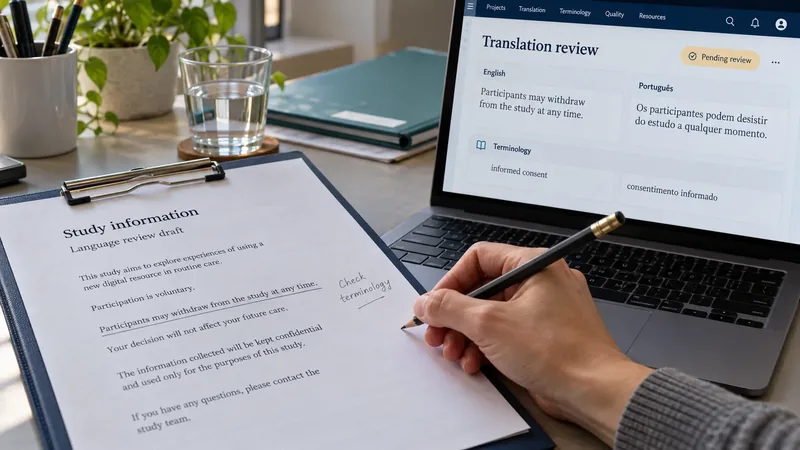
A content ownership plan separates language verification from decisions about the underlying science and authorized use. The translator or post-machine editor checks the target text against the source within the agreed scope. A content reviser provides the specified additional linguistic review. The client’s subject-matter owner resolves technical questions, while designated regulators or other authorized reviewers retain the relevant approval responsibilities.
Specify what “expert editing” means in the quotation. Target-language editing can address readability, grammar, and style, but it should also reflect subject matter expertise in bilingual comparison. Conversely, a sentence true to the source content may still need audience-focused editing. Ask for both activities when necessary, and identify who will confirm readability changes have kept the intended meaning.
Give reviewers a single controlled source version, the translated file, approved reference material, and a defined way to record comments. Separate a translation error from a preference or a requested source change. Resolve conflicting comments through a named owner. Otherwise, successive reviewers can unintentionally reverse earlier decisions or introduce wording that no longer corresponds to the approved source.
Specify Deliverables and Release Criteria
The translation order should describe the desired result as precisely as the production method. State whether delivery includes editable translated files, a formatted review PDF, a bilingual comparison file, or include a record of resolved questions. Request only the records needed to fulfill the requirements and confirm which are included in the scope. Please note these are recommended procurement specifications, not a claim that every Terralíngua assignment includes an identical documentation package.
For example, release criteria might require items such as a source comparison, question resolution, correct incorporation of accepted comments, and checking the final layout. Specify the person authorized to accept the final delivery. Avoid vague instructions such as “make it accurate” without defining the source, references, audience, and checks against which accuracy will be assessed.
Language review and production review also need a clear boundary. Text can be correct in a bilingual file yet appear under the wrong table heading in the exported document. Include a final-format check, especially when the layout carries meaning. Translation alone does not establish clinical safety, regulatory approval, or compliance; those outcomes involve responsibilities beyond the language service.
Compare Current Offer and Future Needs
Compare quotations ensuring equivalent review and delivery scopes. Relevant considerations include file preparation, terminology research, source questions, translation or post-editing, revision, client review, and final-format checks. Remember your part in the process as poor scans, unstable source files, and delayed answers can affect workflows. Do not base a decision on how quickly a system generates translated text or on an assumed percentage saving.
Ensure the preservation of the approved source and target versions stored together. For an update, identify changed passages and any neighboring text whose meaning depends on them. Reuse approved translations only after confirming their continued relevance. A small source change to an exception or qualifier may need more attention than several unchanged paragraphs.
If the system, language pair, content type, or review scope changes, revisit the original decisions. Record which workflow - machine or human - produced each deliverable, particularly when a project mixes methods. Material originally limited to internal distribution should receive the necessary reassessment and review before being reused in participant-facing or publicly published content.
Mixed Document Package Considerations
Consider a fictional biotechnology team commissioning translations of a public research overview, an internal analytical procedure, and a participant information sheet. The files concern the same program, but only selecting a single translation method because they all belong to life sciences would skip the decisions that matter regarding the best protocol for the content. The team should first record the intended use and approval owner for each file before determining the best method for completion.
The public overview uses industry approved, clearly explained language and contains no restricted information. The team should assess machine translation with full post-editing against its publication requirements. The sample should include statements about uncertainty and research limitations, not just the introductory background. If the draft strengthens tentative findings into definite claims, the buyer should reconsider the production method for the content and evaluate the required correction time.
The internal evaluation procedure should include the review of abbreviated steps and references to local equipment names. A restricted audience does not remove the need for precise meaning. Before translation, the technical owner supplies definitions and resolves incomplete instructions. The team may favor human translation with revision because interpreting the source and managing questions with human oversight are central to the assignment. Always require final-format and technical review rather than assuming the method alone will create a final product.
The participant information sheet requires accessible wording and the applicable study review process. The team establishes the approved source, target readership, and required reviewers before commissioning language work. If an AI-assisted method is proposed, its acceptability must be assessed within those constraints. The workflow cannot bypass required approvals, and a favorable sample cannot authorize the final document for use.
If the proposal is approved, the purchase order should confirm the method, review scope, deliverables, and identify the release owner for each group. Shared terms and approved references may connect the package, while still requiring different review needs. These examples illustrate how to reason through a choice; however, they are not fixed rules assigning a production method to every overview, procedure, or participant document.
Frequently Asked Questions
Can We Submit an AI Draft We Have Already Produced?
Yes, you can request an assessment of an existing draft, but acceptance and scope need confirmation. Provide the matching source, explain how the draft was produced, and identify any human changes already made. Ask whether repairing the output is practical or whether a new translation would better meet the project requirements.
Does a Glossary Make Machine Translation Suitable?
A glossary helps establish preferred terms, but it does not verify relationships, omissions, qualifications, or context. Include definitions and relevant references where a term has multiple meanings. Suitability still depends on the source, language pair, intended use, system output, and planned human checks.
Can Different Documents Use Different Workflows?
They can, provided the division decision is outlined and shared terminology remains controlled. Define the method and review scope for each document group, then identify any dependencies between them. Do not let a lightly reviewed internal summary become the unexamined source for material requiring more comprehensive review.
Request an Assessment of Representative Material
Terralíngua’s professional service includes a personalized evaluation of the available method choices including human translation, expert editing, and full human post-editing. An important step is to evaluate the content, language pair, intended readers, and delivery requirements rather than assuming one workflow fits every assignment. Ensure the translation proposal identifies the localization method and if the review is included.
Send representative source files, target languages and regions, intended audience and use, required formats, available references, and the deadline for an accurate proposal. Identify sensitive information and handling restrictions before sharing files, and explain who will answer technical questions and approve the final result. This provides a concrete basis for assessing the material and recommending an appropriate scope.